Rhb payroll processing time
A clear look at how long RHB payroll processing takes and what factors influence speed, with practical tips.
RHB payroll processing time can be quick, especially when payroll submissions align with bank cut-offs and the right tools are used. In practice, how long it takes depends on how you submit payroll, the processing workflow you use, and whether there are any validation steps required by regulatory bodies or your company’s payroll policy. Below is a practical guide to what to expect and how to optimize your timing.

Factors affecting payroll processing time at RHB
| Factor | Impact on Time | Example of Effect | Notes |
|---|---|---|---|
| Data accuracy | High | Fewer corrections | Accuracy reduces back-and-forth |
| Data source quality | High | Clean feeds | Poor feeds cause delays |
| System integration | High | Smooth sync | breaks slow processing |
| Manual approvals | Medium | Waiting for sign-off | Adds lag if bottleneck |
| Payroll rules complexity | Medium | More checks | Increases calc time |
| Data entry volume | Proportional | More records, longer | Cumulative time rises with volume |
| Exception handling | Medium | One-off fixes | Exceptions slow cycles |
| Error rate | High | Rework needed | Rework consumes time |
| System maintenance | Low to medium | Downtime avoidance | Keeps run smooth |
| Compliance checks | Medium | Mandatory verifications | Adds verification steps |
Compiled November 2026; check the provider's site for current details.
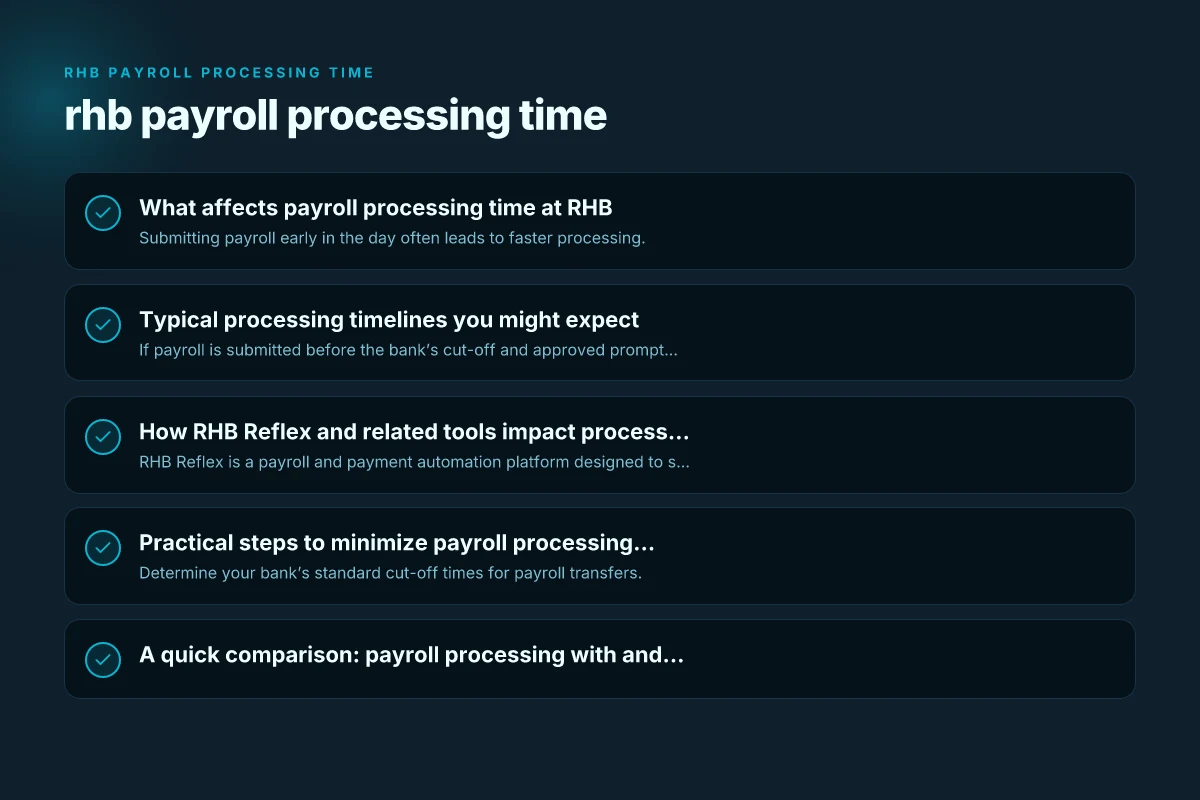
What affects payroll processing time at RHB
Submission timing
- Submitting payroll early in the day often leads to faster processing.
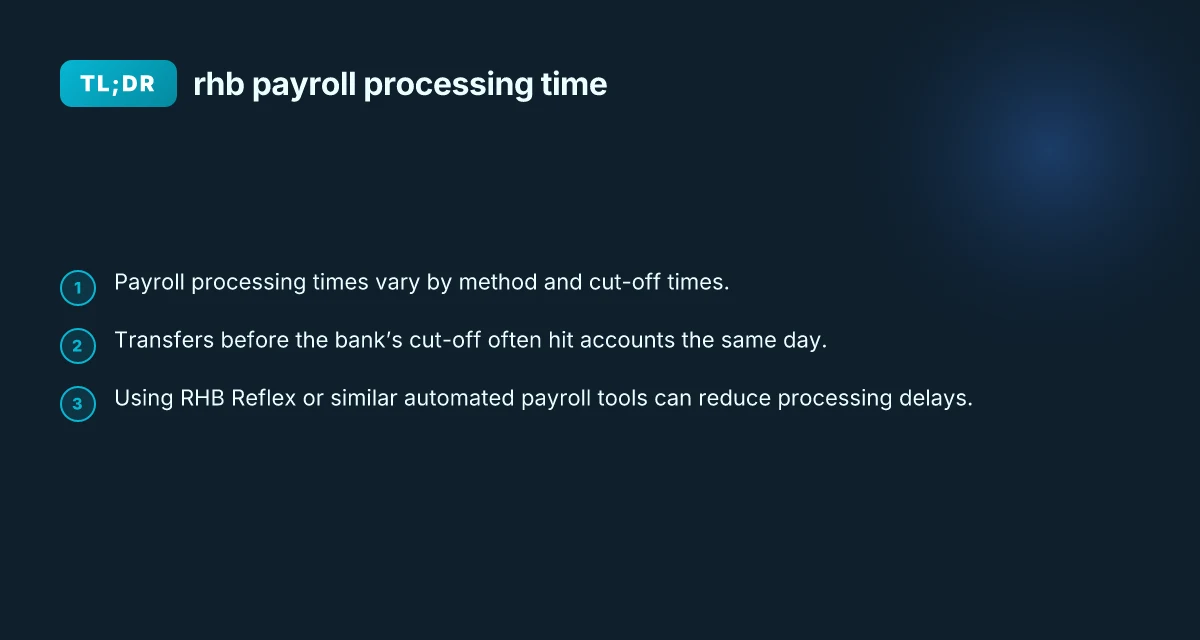
- Some banks operate with same-day credit for transfers if requests are placed before a cut-off time.
Payroll method
- Automated payroll solutions integrated with RHB can speed up processing by reducing manual entry.
- Manual processing typically takes longer due to data checks and approvals.
Approval workflow
- If an Authorizer or approver takes time to sign off, processing can be delayed.
- Timely approvals are crucial for same-day fund disbursement, especially for large payroll runs.
Transfer type and timing
- Local transfers (e.g., within the same bank) are generally faster.
- ERF/EFT-style payroll transfers have specific cut-off times. Transfers after those cut-offs may move to the next business day.
Compliance checks
- Payroll entries may require validation for tax, statutory contributions (e.g., EPF/SOCSO in some markets), and payroll policies.
- Verification steps can add to processing time if not streamlined.
Typical processing timelines you might expect
Same-day credit scenarios
- If payroll is submitted before the bank’s cut-off and approved promptly, beneficiaries may receive funds the same day.
- This is common for internal accounts and standard wage payments where the system confirms and executes quickly.
Next-business-day credit scenarios
- If submission misses the cut-off or approvals are pending, funds may be processed the next business day.
- This is typical in many organizations and can still be same-day for some recipients depending on routing.
Delays due to validation or exceptions
- Payroll with exceptions (e.g., new hires, updated bank details, missing data) can take longer.
- Compliance checks or manual reviews add processing time, especially for large payrolls.
How RHB Reflex and related tools impact processing time
What is RHB Reflex?
- RHB Reflex is a payroll and payment automation platform designed to streamline bulk transfers, automate statutory payments, and reduce manual errors.
Benefits for processing time
- Automation minimizes manual data entry and reconciliation lag.
- Pre-configured workflows can accelerate approval and disbursement.
- Bulk transfers are designed to handle many employees efficiently, aiming for faster overall processing.
Real-world timing with Reflex
- When used with proper cut-off adherence, Reflex can help achieve same-day credit for many payroll recipients.
- If your organization has a consistent monthly payroll schedule, Reflex’s automation reduces delays caused by manual steps.
Typical processing timelines you might expect
| Timeline stage | Typical duration | Dependence | Notes |
|---|---|---|---|
| Data collection | same-day to 2 days | Data quality | Early collection helps |
| Validation & checks | 0.5 to 2 days | Data accuracy | Faster with automation |
| Calculation & payroll run | same-day to 1 day | System speed | Affected by rules |
| Approvals & sign-off | 0.5 to 2 days | Approver availability | Bottleneck if queues |
| Tax & benefits processing | 0.5 to 1 day | Complexity | Standardized rules help |
| Payslip generation | same-day | System | Quick once data ready |
| Dissemination to employees | same-day to 1 day | Delivery method | Email/portal latency |
| Year-end/adjustments | days to weeks | Volume | Special processing required |
| Error corrections | variable | Rework needed | Depends on issues found |
| Audit/compliance review | 0.5 to 2 days | Scope | Occasional requirement |
Compiled November 2026; check the provider's site for current details.
Practical steps to minimize payroll processing time
Align with bank cut-offs
- Determine your bank’s standard cut-off times for payroll transfers.
- Schedule payroll submissions to land before those cut-offs whenever possible.
Use automated solutions
- Implement RHB Reflex Premium or similar automation to reduce manual processing errors.
- Ensure data feeds (employee records, salary components, deductions) are clean before submission.
Streamline approvals
- Create clear, time-bound approval processes.
- Use digital signatures or centralized approvers to speed up the final sign-off.
Prepare data in advance
- Keep employee data current: bank accounts, tax IDs, and statutory contributions.
- Validate payroll inputs ahead of the processing date to avoid rework.
Monitor and test cycles
- Run test payrolls during off-peak times to verify data flows.
- Regularly audit for data mismatches and missing fields that typically cause rejections.
A quick comparison: payroll processing with and without automation
| Aspect | With Automation (e.g., RHB Reflex) | Without Automation |
|---|---|---|
| Data entry speed | Fast, bulk-ready; reduced manual entry | Slow; one-by-one entry risk of error |
| Error rate | Lower due to validation rules | Higher; more rework and corrections |
| Approval time | Often streamlined with digital workflows | Potential delays due to paper trails |
| Cut-off adherence | Easier to align with bank cut-offs | More prone to timing misalignment |
| Overall processing time | Shorter; potential same-day credits | Longer; next-day or delayed credits |
Frequently asked questions
Q: How long does it take for RHB payroll processing to complete in Malaysia?
- Timelines vary by submission timing, whether automation is used, and the bank cut-offs. In optimal conditions (before cut-off and with automated workflows), many payrolls can settle the same day. Delays occur if submissions miss cut-offs or require manual validation.
Q: How long does payroll processing take in general?
- It ranges from several hours to a full business day, depending on data readiness, approvals, and whether the transaction is processed in real-time or batched.
Q: How long does it take to get an RHB loan approved? Radmin not working
- This is a different product area. Loan approval times depend on credit checks, documentation quality, and underwriting policies. It’s not directly tied to payroll processing times.
Q: How long does a RHB transfer take?
- RHB GIRO or standard transfers made before cut-offs are typically credited the same business day. Transfers after cut-offs or on holidays may take until the next business day.
Final recommendations
- If you manage payroll for a company using RHB, map out your bank cut-off times and build a schedule that has payroll data ready well before those deadlines.
- Invest in an automated payroll solution like RHB Reflex Premium Plus or equivalent to minimize manual steps and speed up processing.
- Maintain clean, up-to-date employee data to avoid rework and delays caused by missing or mismatched information.
- Establish a clear approval SLA (service level agreement) so approvers know when to respond and avoid bottlenecks.
- Run periodic dry runs or test payroll cycles to identify potential delays before the actual payday.
In short, the speed of payroll processing with RHB depends on submission timing, whether you’re using automation, and how tight your approval and data validation processes are. When everything aligns, early submission, automated workflows, and prompt approvals, payday can feel instant for many employees, with funds appearing the same day.