Turn off Surfshark VPN
A practical guide to turning off Surfshark VPN across devices, including kill switch, auto-connect, and subscription basics.
Turning off Surfshark VPN is straightforward, whether you want to exit the VPN manually for a moment or plan to stop using the service on a device. This guide walks you through the most common scenarios: turning off the VPN on a single device, disabling the kill switch, pausing auto-connect, and what to expect for subscriptions when you decide to turn things off.

Compare how to turn off Surfshark VPN by device
| Device type | How to turn off | Kill switch effect | Auto-connect | Uninstall need | Notes |
|---|---|---|---|---|---|
| Windows | Through app: Disconnect | Stops VPN traffic immediately | Applies per app | Not required for turn-off | If exiting app, still may run background service |
| macOS | Through app: Disconnect | Stops VPN traffic immediately | Applies per app | Not required for turn-off | Menu bar icon shows status |
| iOS | In-app: Disconnect | Stops VPN traffic immediately | System-wide? limited | Not required for turn-off | Screen lock doesn’t re-enable automatically |
| Android | In-app: Disconnect | Stops VPN traffic immediately | Auto-connect may be off when disabled | Not required for turn-off | Battery optimization may affect behavior |
| Browser-only mode | Toggle off in extension | VPN not active for browser | No cross-app effect | No | Only affects browser traffic |
| Routers | Disable VPN profile on router | VPN traffic stops for all devices on network | Global setting | N/A | Requires router access |
Compiled November 2026; check the provider's site for current details.
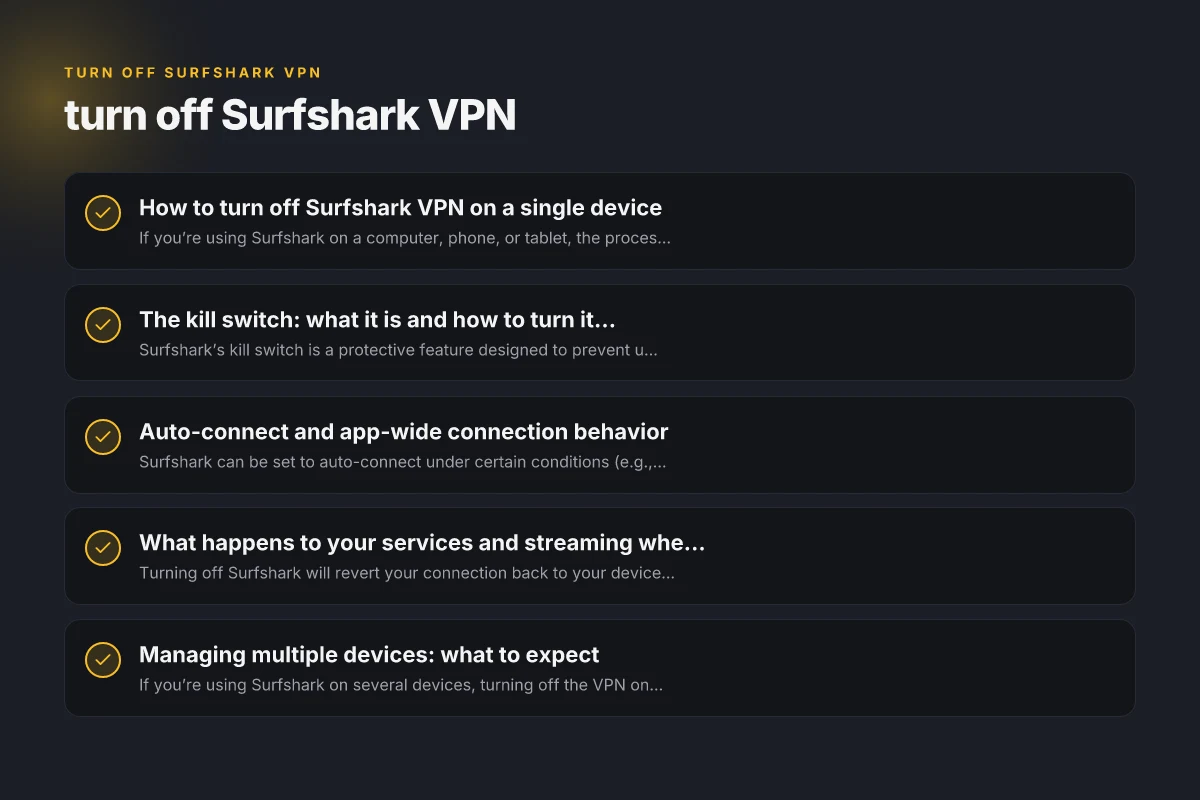
How to turn off Surfshark VPN on a single device
If you’re using Surfshark on a computer, phone, or tablet, the process to turn off the VPN is typically the same in the app:
- Open the Surfshark app.
- Look for the big toggle button that indicates “Connected.” Tap or click it to disconnect.
- Confirm if prompted. The app will indicate you are no longer connected to a VPN server.
- Some platforms show a status banner or a system tray icon update to reflect the disconnected state.
On mobile devices (iOS and Android) you can also pull down on the main screen to reveal a Quick Toggle in the app, but the primary method remains the big connect/disconnect button.
If you prefer to turn off the VPN from the device’s system settings (not recommended for quick disconnection), you can disconnect the Surfshark profile or VPN connection in:
- Windows: Settings > Network & Internet > VPN > select Surfshark > Disconnect
- macOS: System Preferences > Network > Surfshark > Disconnect
- iOS/Android: Settings > VPN (or Surfshark in the quick settings/airplane mode panel) > Disconnect
Note: If you simply disconnect, Surfshark won’t route traffic through its servers until you reconnect. Your regular internet connection will resume with your usual IP address unless you have other network configurations active.
The kill switch: what it is and how to turn it off
Surfshark’s kill switch is a protective feature designed to prevent unencrypted or leaked traffic if the VPN connection drops. If you’re troubleshooting or only using Surfshark intermittently, you may want to disable it temporarily or permanently: VPN Xbox browser
- Open the Surfshark app.
- Go to Settings.
- Find VPN settings and locate the kill switch option.
- Toggle the kill switch to Off.
Important considerations:
- With the kill switch off, you may temporarily leak your real IP if the VPN connection drops.
- If you plan to continue using Surfshark but want occasional exposure, consider turning the kill switch back on after your task.
If you ever re-enable the VPN to protect your traffic, you can switch the kill switch back on by returning to Settings > VPN settings > Kill switch and toggling it On.
Compare kill switch behavior when Surfshark is off
| Scenario | Kill switch status | Impact on traffic | Re-enabling effect | When off | Notes |
|---|---|---|---|---|---|
| Kill switch on, VPN off | Disabled (not enforcing) | Regular traffic may flow | Needs VPN on to re-engage | VPN off or app closed | Use only for protection when VPN on |
| Kill switch off, VPN off | No protection | Traffic uses default route | N/A | Always off | Not protective by design |
| Kill switch on, VPN on | Active | Protects by blocking leaks | Re-engage automatically | VPN on | Core safety feature |
| Kill switch off, VPN on | Not active | Potential leaks possible | N/A | VPN on | Optional safety toggle |
Compiled November 2026; check the provider's site for current details.
Auto-connect and app-wide connection behavior
Surfshark can be set to auto-connect under certain conditions (e.g., when the device starts, when you join unsecured networks, or based on app rules). Turning off auto-connect is useful if you want full control over when the VPN is active: NordVPN blocking Google
- In the Surfshark app, navigate to Settings.
- Look for Auto-connect or Connect on start.
- Toggle Auto-connect Off.
When Auto-connect is off, Surfshark will only connect when you manually press the Connect button. This makes it easier to keep your device on a normal network status until you choose to enable the VPN.
What happens to your services and streaming when you turn off Surfshark
Turning off Surfshark will revert your connection back to your device’s standard IP and network routing. This can affect:
- Access to geo-restricted content: You may lose access to catalogs available only on certain servers.
- Anonymity and privacy: Your IP is no longer masked by Surfshark while you’re disconnected.
- Bandwidth and throttling: Some networks may treat VPN traffic differently, so you might notice changes in speed at times.
If you rely on a particular server for streaming or unblocking content, you’ll need to reconnect to Surfshark and select a server that suits your needs.
Managing multiple devices: what to expect
If you’re using Surfshark on several devices, turning off the VPN on one device does not affect others. Each device has its own connection state, kill switch status, and auto-connect rules. To turn off Surfshark on multiple devices, repeat the steps on each device:
- Disconnect from the VPN in the Surfshark app on that device.
- Optionally disable the kill switch and auto-connect if desired.
- Confirm the device shows as disconnected in the app.
If you are planning a longer break from Surfshark on all devices, you may consider uninstalling the app or signing out from your account on devices where you don’t plan to use the VPN. Microsoft Edge secure network VPN: what it is, how it works, and what to know
A quick comparison: turning off vs. uninstalling Surfshark
| Scenario | What happens | Pros | Cons |
|---|---|---|---|
| Turn off (disconnect) | VPN is off; normal internet resumes | Fast to re-connect; no data loss on app settings | Traffic may leak if kill switch is off when disconnected |
| Turn off kill switch only | VPN can be turned off without affecting other protections | Keeps kill switch ready when you reconnect | Doesn’t address auto-connect behavior |
| Turn off auto-connect | You must manually connect; VPN remains installed | You control when VPN starts; reduces unexpected connections | You must remember to connect when needed |
| Uninstall Surfshark | App removed from device; settings reset when reinstalled | Frees storage; no background processes | Reinstall required to use VPN again; may need account setup again |
How to cancel or manage your Surfshark subscription (brief overview)
Sometimes people turn off the VPN but still want to manage billing or subscriptions. Here are quick pointers:
- Subscriptions are usually managed through the platform you used to purchase (e.g., Surfshark account on their website, or app store billing if you subscribed there).
- If you want to stop auto-renewal, you typically need to go to your Surfshark account page and adjust renewal settings or contact support for assistance.
- If you’re ensuring you won’t be charged, you may also cancel the subscription in the store where you subscribed, but check the refund policy for eligibility.
Note: Specific steps can vary depending on the device and platform (iOS App Store, Google Play, Windows, macOS). If you’re unable to cancel or facing billing issues, Surfshark’s support articles and help center can provide platform-specific steps.
Auto-connect and app-wide connection behavior when turning off Surfshark
| Setting | Behavior when turned off | Per-device effect | App-wide effect | Re-enabling | Notes |
|---|---|---|---|---|---|
| Auto-connect enabled | No VPN connection | May attempt reconnect on device | Global if multiple devices | Re-enable auto-connect on app | May require app restart |
| Auto-connect disabled | No automatic connect | No reconnect attempts | Global if disabled | Re-enable to re-activate | Manual connect needed later |
| App-wide connection on | VPN disabled in app | No traffic routed | Global across devices | Turn on app-wide to re-enable | Check per-device overrides |
| Per-device overrides | Individual behavior remains until app sync | Some devices may stay connected | Inconsistent if sync not immediate | Reconcile settings on all | Override may persist locally |
Compiled November 2026; check the provider's site for current details.
Short final section: recommendation
If your goal is simply to stop using Surfshark temporarily, the quickest and most reliable path is to open the Surfshark app on the device and press the disconnect button. If you’re worried about traffic leaks during a temporary outage, consider turning the kill switch back on after you reconnect, or leave it off only while you’re sure the VPN won’t drop. For longer breaks, you can either turn off auto-connect and uninstall the app, or keep the app installed and manage your subscription through the account page when you’re ready to return. SSL VPN poscoenc: What POSCO E&C users should know about SSL VPN
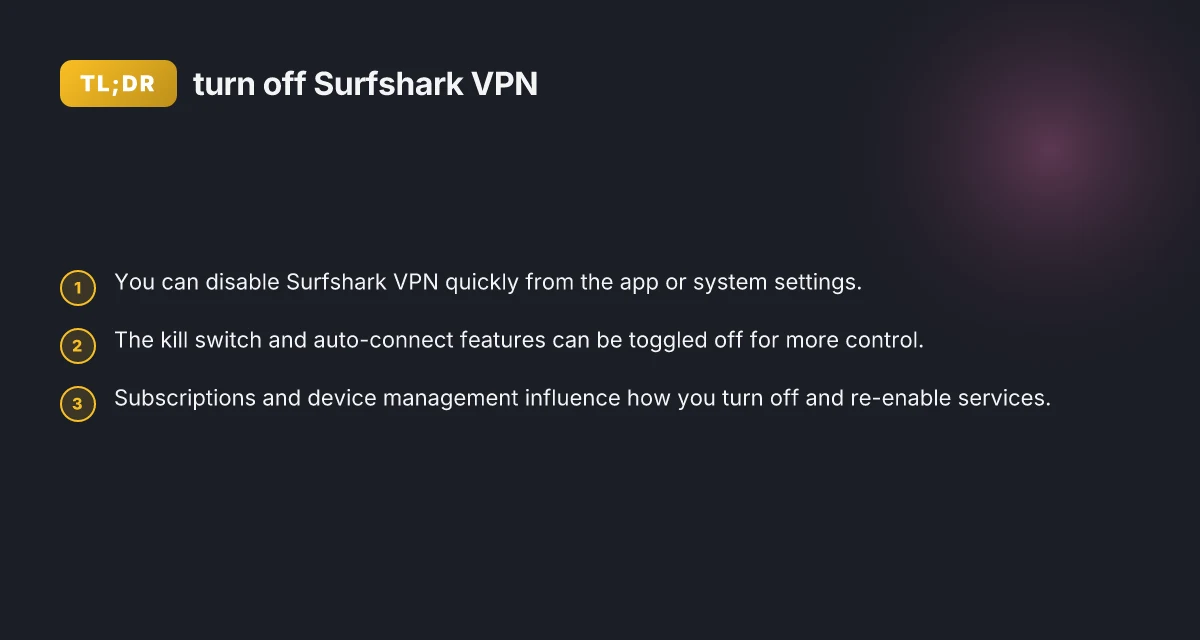
Bottom line: Turning off Surfshark VPN is a momentary action that can be fully controlled at the device level. Whether you’re troubleshooting, conserving battery, or pausing service, you have clear options to disconnect, adjust kill switch behavior, and manage auto-connect to fit your browsing needs.
| VPN | From / month | Plan | Free plan | Refund | Alipay | UnionPay | Crypto | Website opens in China | Trustpilot | |
|---|---|---|---|---|---|---|---|---|---|---|
 Surfshark | See site | See site | No | 30 days | ✗ | ✗ | ✗ | ✓ | ✗ Blocked | 4.3/5 (31,823 reviews) |
 ZoogVPN | $2.49/mo | 27 months: $59.99 | Yes | 7 days | ✓ | ✓ | ✓ | ✓ | ✓ Yes (2.5 s) | 4.2/5 (195 reviews) |
 NordVPN | $3.49/mo | 27 months: $94.23 | No | 30 days | ? | ✗ | ✓ | ✓ | ✗ Blocked | 4.2/5 (51,628 reviews) |
 ExpressVPN | $3.00/mo | 28 months: $84 | No | 30 days | ✗ | ✗ | ✓ | ✗ | ✗ Blocked | 4.4/5 (29,706 reviews) |
 Proton VPN | $2.99/mo | 12 months: $35.88 | Yes | 30 days | ✗ | ✗ | ✗ | ✓ | ✓ Yes (2.5 s) | 2.1/5 (1,040 reviews) |
 Astrill VPN | $12.50/mo | 24 months: $300 | No | See site | ✗ | ✗ | ✗ | ✓ | ✗ Blocked | 1.3/5 (110 reviews) |
 Private Internet Access | $2.03/mo | 40 months: $81.2 | No | 30 days | ✗ | ✗ | ✗ | ✗ | ✗ Blocked | 4.2/5 (11,033 reviews) |
 CyberGhost | $2.19/mo | 28 months: $61.32 | No | 45 days | ✗ | ✗ | ✗ | ✓ | ✗ Blocked | 4.0/5 (24,178 reviews) |
 PureVPN | $1.69/mo | 60 months: $101.55 | No | 31 days | ? | ✗ | ✗ | ✓ | ✓ Yes (2.6 s) | 4.4/5 (17,994 reviews) |
 AdGuard VPN | $2.99/mo | 24 months: $71.76 | Yes | 30 days | ✓ | ✗ | ✓ | ✓ | Official site blocked; our special link opens (2.3 s) | 4.3/5 (290 reviews) |
 Mullvad | $5.61/mo | €5/mo | No | 14 days | ✗ | ✗ | ✗ | ✓ | ✗ Blocked | 3.2/5 (192 reviews) |
 Windscribe | $5.75/mo | 12 months: $69 | Yes | See site | ✗ | ✗ | ✗ | ✓ | ✗ Blocked | 4.7/5 (13,355 reviews) |
 StrongVPN | See site | See site | No | 30 days | ✓ | ✗ | ✗ | ✗ | ✗ Blocked | 4.4/5 (2,695 reviews) |
 LightXtreme 闪连 | $7.08/mo | 12 months: $84.99 | Yes | 30 days | ✓ | ✓ | ✓ | ✓ | ✓ Yes (2.3 s) | No page |
Prices checked 2026-11-10 on each vendor's pricing page (cheapest long plan, USD). Check the vendor's checkout for the final price.
Payment methods checked 2026-11-10 on each vendor's payment pages: all 14 take cards and PayPal; ✗ = not listed, ? = the vendor's own pages disagree.
China access: whether the official website opens from mainland China networks (tests the website only, not the VPN connection). Last checked 2026-11-11 04:07 Beijing time.
Trustpilot score and review count checked 2026-11-10.