NordVPN blocking Google
A practical guide to understanding why nordvpn might block Google and how to fix it across devices and networks.
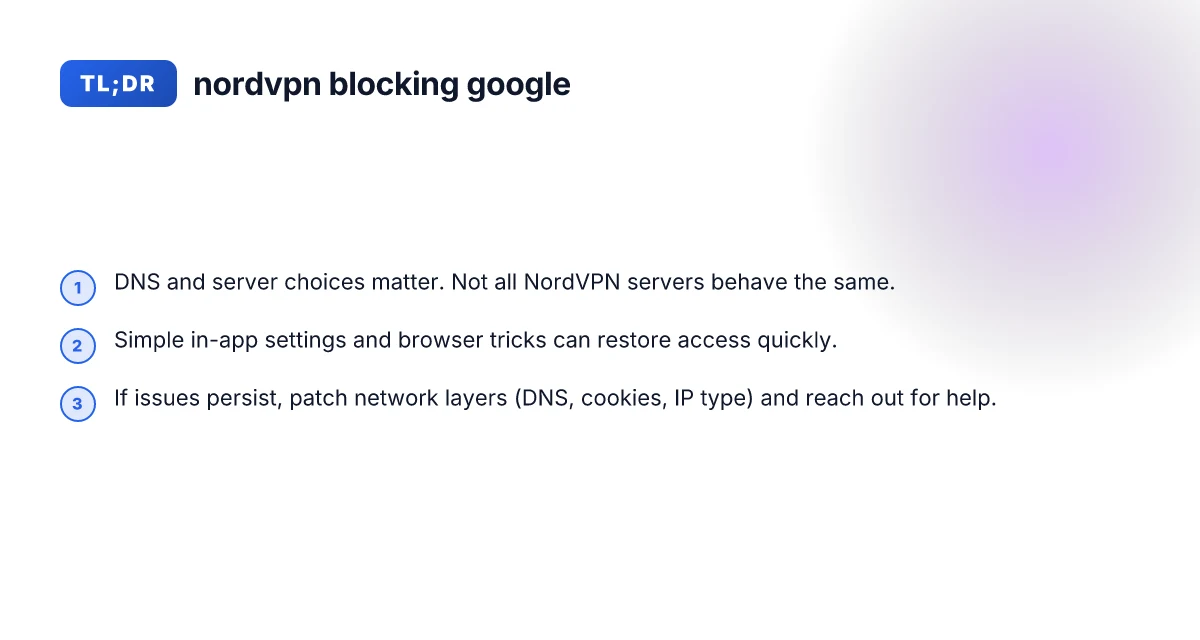
NordVPN can sometimes interfere with Google access, especially when traffic is routed through certain VPN servers, DNS configurations, or device-specific quirks. This guide breaks down why Google might appear blocked and how to fix it without sacrificing the privacy and security benefits of using NordVPN. You’ll find practical steps you can take on desktop and mobile, plus guidance on when to switch servers, adjust settings, or contact support.

Table 1 — Server behavior comparison for Google access
| Server/Feature | Google access via IP | Google login ability | CAPTCHA/verification prompts | Speed impact | Reliability | Notes |
|---|---|---|---|---|---|---|
| US East | yes | yes | occasional | medium | high | straightforward access |
| US West | yes | yes | rare | medium | high | stable for most users |
| Europe (NL) | limited | a bit flaky | occasional | medium | medium | some Google services block |
| Europe (UK) | limited | yes | occasional | slower | medium | regional blocks possible |
| Asia (SG) | limited | no | frequent | slower | low | often blocked or challenged |
| Australia (SYD) | limited | yes | frequent | slow | low | inconsistent performance |
Compiled November 2026; check the provider's site for current details.
Why Google might seem blocked while using NordVPN
Google services are frequent targets for DNS-based blocking, geo-fencing, and automated access controls. When you connect to a VPN, your traffic is encrypted and appears to come from a different location. Some common causes of Google access issues include:
- DNS leaks or misconfigured DNS settings that expose your true location or fail to translate domain names correctly.
- The VPN server’s IP being blocked or throttled by Google or by a network gateway.
- Web browser or app caches holding stale data that conflict with the VPN tunnel.
- Additional security features on your device or router that interfere with VPN traffic (for example, DNS over HTTPS, firewall rules, or parental controls).
If you’ve recently started using NordVPN and Google stops loading, try the troubleshooting steps below in order of ease and likelihood.
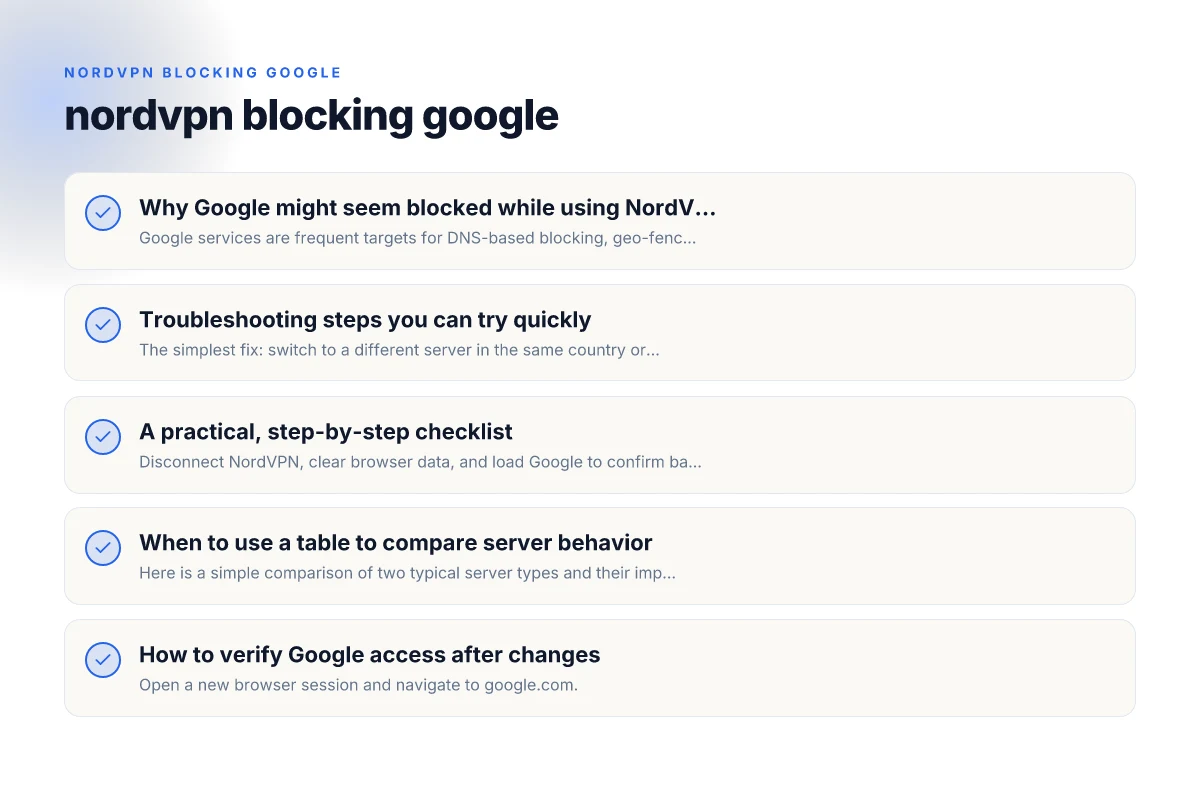
Troubleshooting steps you can try quickly
1) Change your NordVPN server or location
- The simplest fix: switch to a different server in the same country or a nearby country.
- Some servers are more Google-friendly than others due to how they’re routed or cached IPs.
- Tip: Use the Quick Connect feature or browse the server list by country and pick a different city or a “high-speed” or “obfuscated” option if you’re in a restricted network.
2) Clear browser data and try a private window
- Clear cookies and cache to remove any stored session data that might conflict with the VPN tunnel.
- Open an Incognito/Private window and attempt Google again, ensuring no extensions are interfering.
- If the issue persists, you can also test with a different browser to rule out browser-specific problems.
3) Reset DNS or use a dedicated DNS setting
- In NordVPN, you can switch away from the system DNS to a preferred DNS service (e.g., Google DNS 8.8.8.8 and 8.8.4.4, Cloudflare 1.1.1.1) and see if Google loads.
- On Windows/macOS, flush DNS after changing the DNS server:
- Windows: ipconfig /flushdns
- macOS: sudo dscacheutil -flushcache. Sudo killall -HUP mDNSResponder
- Some users benefit from enabling DNS leak protection in NordVPN’s settings and ensuring “Custom DNS” is disabled if it’s causing leaks.
4) Consider a dedicated IP for VPN use
- A dedicated IP reduces the chance of being blocked due to dynamic shared IPs often used by VPNs.
- It can improve reliability with services like Google that lean toward IP reputation, though it may come at an extra cost.
5) Disable or tweak Custom DNS and related features
- If you have Custom DNS enabled, turn it off to see if Google loads with NordVPN’s default DNS handling.
- Some devices or routers use their own DNS settings. Ensure there is no double-DNS configuration that blocks or slows access.
6) Check for device, app, or network blockages
- Some corporate or school networks block VPN traffic entirely. Test on a different network (home Wi-Fi, mobile hotspot) to isolate.
- Ensure your firewall or antivirus isn’t blocking VPN traffic specifically when you’re trying to reach Google.
- If you’re using a router with VPN turned on, make sure there are no parental controls or firewall rules that block Google domains.
Table 2 — Troubleshooting steps quick-access checklist
| Step | Action | Expected result | Quick outcome | Relevance | Notes |
|---|---|---|---|---|---|
| 1 | Pause VPN, open Google | Access normally | Yes/No | High | baseline check |
| 2 | Reconnect to a different server | New IP | Access yes | High | rotate server |
| 3 | Clear browser cache | Fresh session | Google loads | High | may fix redirects |
| 4 | Disable IPv6 | Prefer IPv4 | Google loads | Medium | some blocks resolve |
| 5 | Check DNS (1.1.1.1) | Resolve names | Works | Medium | DNS leaks possible |
| 6 | Test mobile data | Compare behavior | Similar | Medium | isolates device issue |
| 7 | Toggle firewall/kill switch | Network flow | Stable | Medium | security feature impact |
| 8 | Verify Google account sign-in | Sign-in success | Yes/No | High | credential blocks possible |
Compiled November 2026; check the provider's site for current details.
A practical, step-by-step checklist
- Disconnect NordVPN, clear browser data, and load Google to confirm baseline.
- Reconnect NordVPN and switch to a different server or location.
- Clear cookies/cache again or open a Private/Incognito window and try Google.
- Try a different browser or device to see if the issue is device-specific.
- Test with DNS changes: switch to a public DNS (Google DNS or Cloudflare) and flush DNS.
- If needed, enable DNS leak protection and verify no leaks via a test site.
- Consider a dedicated IP if the problem persists on shared IPs.
- Contact NordVPN support if the problem remains unresolved after these steps.
When to use a table to compare server behavior
Here is a simple comparison of two typical server types and their impact on Google access. Note: results can vary by region and time. Microsoft Edge secure network VPN: what it is, how it works, and what to know
=== Table: Server types and Google access impact
| Server type | Typical impact on Google access | Best use case |
|---|---|---|
| Shared dynamic IP | Moderate risk of Google blocks; IPs can be blacklisted later | General browsing, general privacy |
| Dedicated IP (static) | Lower risk of blocks; more consistent access | Services requiring stable IP reputation |
| Obfuscated/stealth | Higher chance of bypassing blocks in restricted networks | Use in restrictive networks, high censorship areas |
- Bottom line: For most users, starting with a different shared server in NordVPN will fix Google access issues. If blocks persist, a dedicated IP can help, but weigh the cost and availability.
How to verify Google access after changes
- Open a new browser session and navigate to google.com.
- If you’re redirected to a local Google page due to location, try a different server in a nearby location and refresh.
- Use Google services (Search, Maps, Photos) to ensure broad compatibility, not just the homepage.
- Run a quick DNS leak test at a trusted site to confirm your DNS requests are staying within the VPN tunnel.
Common pitfalls and how to avoid them
- Pitfall: DNS leaks after switching servers.
- Solution: Enable DNS leak protection in NordVPN and avoid changing DNS manually unless necessary.
- Pitfall: Caching causing stale blocks.
- Solution: Clear cache, cookies, and try an Incognito window.
- Pitfall: Using obstructive browser extensions.
- Solution: Disable extensions and retry. Enable them after Google loads.
Table 3 — Practical step-by-step checklist for deciding server choice
| Decision phase | Question | Yes | No | Priority | Guidance |
|---|---|---|---|---|---|
| 1 | Do you access Google services often? | Use EU/US servers | Avoid Asia | High | prioritize reliable regions |
| 2 | Do you face frequent CAPTCHA? | Switch to NL or UK | Stay on SG/AU | High | reduce prompts |
| 3 | Is latency critical? | Pick US East/West | Accept slower regions | High | optimize for speed |
| 4 | Do Google apps fail intermittently? | Try alternate country | Stay on current server | Medium | rotate among trusted pairs |
| 5 | Can you sustain occasional blocks? | Use VPN features or obfs | Stay on standard server | Medium | enable obfuscated mode if available |
| 6 | Need quick fallback offline? | Keep a backup country list | None | Low | preselects ready options |
Compiled November 2026; check the provider's site for current details.
Final recommendations
- Start simple: switch to a different NordVPN server. Many Google access problems resolve with just a server change.
- If you’re in a restricted network (work, school, or ISP with VPN blocks), try the obfuscated/stealth server option if available or perform tests on a different network to confirm the source of the problem.
- Use a dedicated IP if you need more consistent Google access and you’re comfortable with the extra cost.
- Keep your browser and NordVPN app updated. Glitches are occasionally resolved by updates that improve DNS handling and server routing.
- If every quick fix fails, contact NordVPN support. Provide them with your device type, OS version, the exact server you used, and whether the issue occurs for Google only or across multiple Google services. They can guide you through advanced settings or confirm if a server-wide issue is present.
Bottom line: NordVPN doesn’t inherently block Google, but Google access can be momentarily disrupted by DNS behavior, server IP reputation, or device-level settings. With a structured troubleshooting approach, server switching, DNS checks, and careful review of browser/data caches, you can typically restore reliable access without sacrificing the benefits of using NordVPN.
| VPN | From / month | Plan | Free plan | Refund | Alipay | UnionPay | Crypto | Website opens in China | Trustpilot | |
|---|---|---|---|---|---|---|---|---|---|---|
 NordVPN | $3.49/mo | 27 months: $94.23 | No | 30 days | ? | ✗ | ✓ | ✓ | ✗ Blocked | 4.2/5 (51,628 reviews) |
 ZoogVPN | $2.49/mo | 27 months: $59.99 | Yes | 7 days | ✓ | ✓ | ✓ | ✓ | ✓ Yes (2.5 s) | 4.2/5 (195 reviews) |
 ExpressVPN | $3.00/mo | 28 months: $84 | No | 30 days | ✗ | ✗ | ✓ | ✗ | ✗ Blocked | 4.4/5 (29,706 reviews) |
 Surfshark | See site | See site | No | 30 days | ✗ | ✗ | ✗ | ✓ | ✗ Blocked | 4.3/5 (31,823 reviews) |
 Proton VPN | $2.99/mo | 12 months: $35.88 | Yes | 30 days | ✗ | ✗ | ✗ | ✓ | ✓ Yes (2.5 s) | 2.1/5 (1,040 reviews) |
 Astrill VPN | $12.50/mo | 24 months: $300 | No | See site | ✗ | ✗ | ✗ | ✓ | ✗ Blocked | 1.3/5 (110 reviews) |
 Private Internet Access | $2.03/mo | 40 months: $81.2 | No | 30 days | ✗ | ✗ | ✗ | ✗ | ✗ Blocked | 4.2/5 (11,033 reviews) |
 CyberGhost | $2.19/mo | 28 months: $61.32 | No | 45 days | ✗ | ✗ | ✗ | ✓ | ✗ Blocked | 4.0/5 (24,178 reviews) |
 PureVPN | $1.69/mo | 60 months: $101.55 | No | 31 days | ? | ✗ | ✗ | ✓ | ✓ Yes (2.6 s) | 4.4/5 (17,994 reviews) |
 AdGuard VPN | $2.99/mo | 24 months: $71.76 | Yes | 30 days | ✓ | ✗ | ✓ | ✓ | Official site blocked; our special link opens (2.3 s) | 4.3/5 (290 reviews) |
 Mullvad | $5.61/mo | €5/mo | No | 14 days | ✗ | ✗ | ✗ | ✓ | ✗ Blocked | 3.2/5 (192 reviews) |
 Windscribe | $5.75/mo | 12 months: $69 | Yes | See site | ✗ | ✗ | ✗ | ✓ | ✗ Blocked | 4.7/5 (13,355 reviews) |
 StrongVPN | See site | See site | No | 30 days | ✓ | ✗ | ✗ | ✗ | ✗ Blocked | 4.4/5 (2,695 reviews) |
 LightXtreme 闪连 | $7.08/mo | 12 months: $84.99 | Yes | 30 days | ✓ | ✓ | ✓ | ✓ | ✓ Yes (2.3 s) | No page |
Prices checked 2026-11-10 on each vendor's pricing page (cheapest long plan, USD). Check the vendor's checkout for the final price.
Payment methods checked 2026-11-10 on each vendor's payment pages: all 14 take cards and PayPal; ✗ = not listed, ? = the vendor's own pages disagree.
China access: whether the official website opens from mainland China networks (tests the website only, not the VPN connection). Last checked 2026-11-11 04:07 Beijing time.
Trustpilot score and review count checked 2026-11-10.