In August or on August: choosing the correct preposition

A clear guide to when to use in August versus on August, with rules, examples, and common pitfalls.
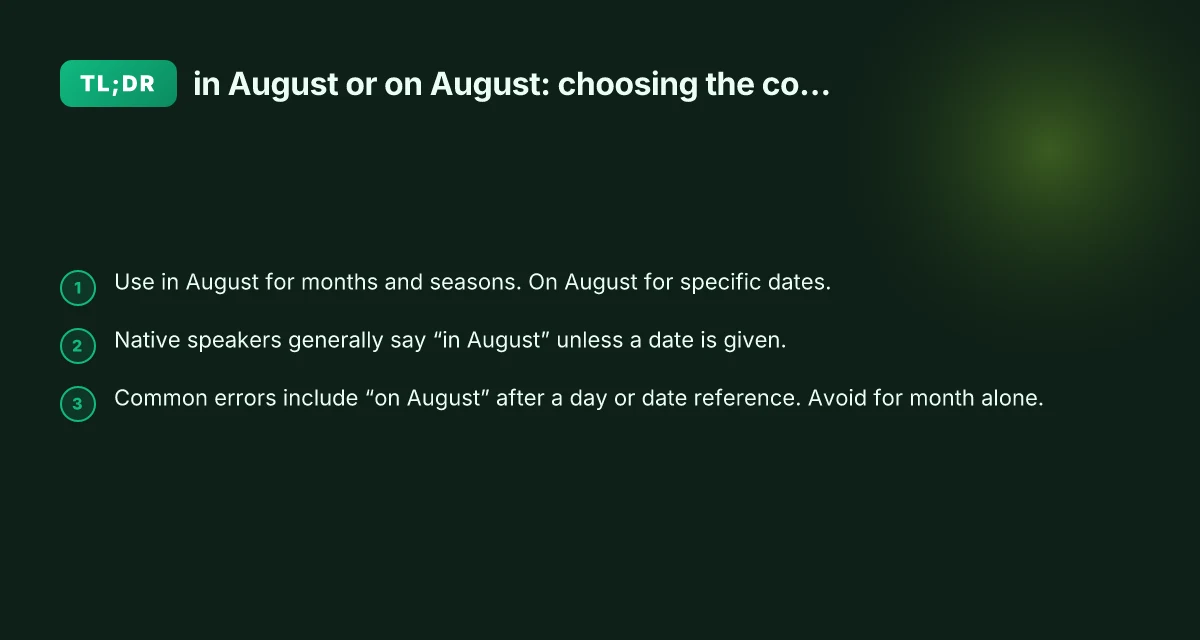
The choice between in August and on August is a small preposition decision, but it matters for clarity and natural English. Most speakers use in August when talking about the month as a general time period. They will switch to on August when a specific date within August is mentioned, such as August 12, 2024, or when the sentence emphasizes a fixed day.

Quick reference — when to use in August vs on August
| Preposition | Time frame | Example (short) | Note |
|---|---|---|---|
| in | month (unspecified day) | in August | general month duration |
| on | specific day | on August 5 | day-focused date |
| in | part of month (not day) | in early August | approximate period within month |
| on | date with day only | on August 5 | needs exact day |
| no preposition | uncommon; use month name alone | August | stylistic, rare without preposition |
| with phrasing | ; alternative forms | in August 2024 | year is allowed with in |
Compiled November 2026; check the provider's site for current details.
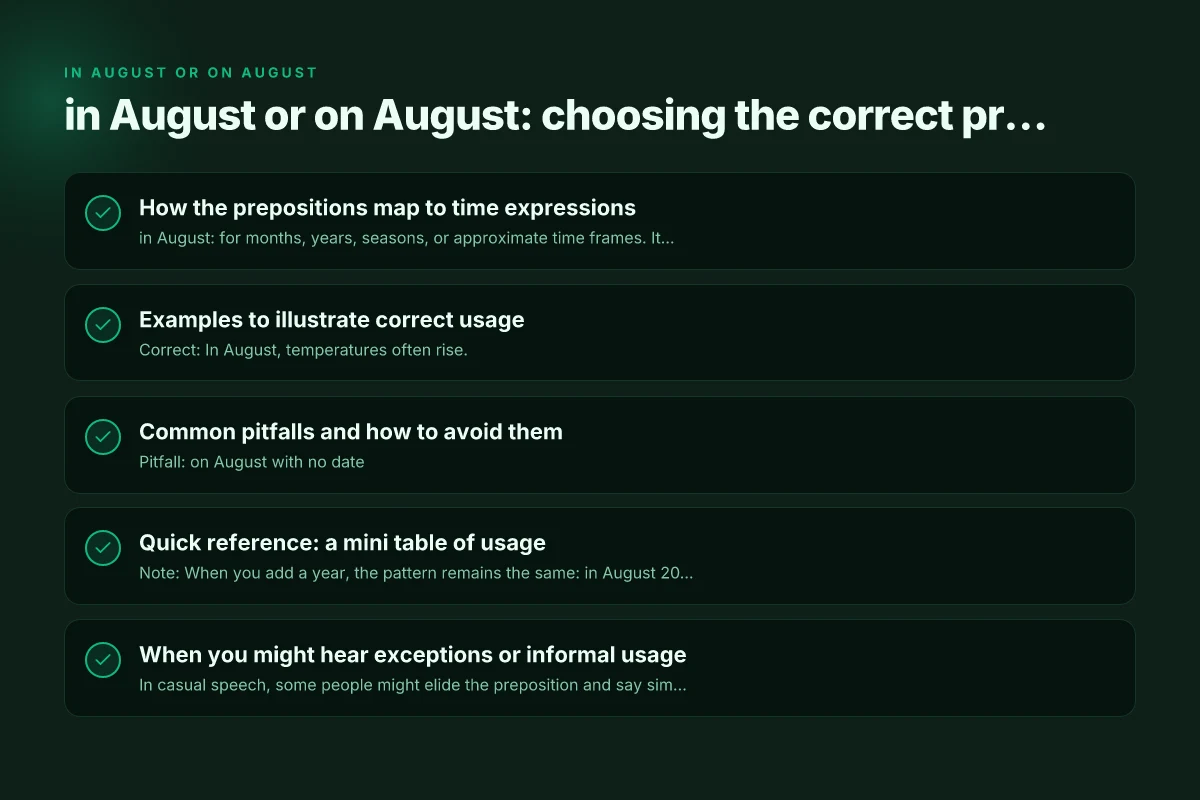
How the prepositions map to time expressions
- in August: for months, years, seasons, or approximate time frames. It’s the default when you’re speaking about something happening sometime during August, without pinpointing a day.
- on August: only when you’re pointing to a specific day within August, or when constructing a sentence that emphasizes a precise date. In most cases, using on with just the month sounds awkward or wrong.
Common patterns:
- In August, the weather tends to be hot.
- The concert is on August 12. (specific date)
- She was born in August. (month of birth)
Examples to illustrate correct usage
- Correct: In August, temperatures often rise.
- Correct: The festival happens on August 5.
- Correct: We’ll travel in August.
- Incorrect: We’ll travel on August. (This sounds like you’re fixing a day, but there’s no day provided.)
A few labeled examples:
- In August, many families take summer vacations.
- The meeting is on August 21 at 3 PM.
- She started her job in August of last year.
- Our project begins in August, not July.
Common pitfalls and how to avoid them
- Pitfall: on August with no date
- What to do: Use in August. “She will start on August” is incorrect. Say “She will start in August.”
- Pitfall: mixing American and British usage
- In American English, in August is standard for the month. “On August” is reserved for dates.
- In British English, the same rule generally applies: in August for the month. On August 12 for a specific date.
- Pitfall: using on with seasons
- Do not say on August when you mean August in general. Say in August.
Practical usage guide — common vs. pitfall pairs
| Pair / Situation | Correct usage | Common pitfall | Quick tip |
|---|---|---|---|
| in August | X | on August | use in for month, on for specific date |
| on August 5 | X | August 5 (without preposition) | reserve for day-specific dates |
| early August | X | on early August | use in for early-month range |
| August 5 | no preposition (when used as a header) | on August 5 | prefer standard date with preposition in prose |
Compiled November 2026; check the provider's site for current details.
Quick reference: a mini table of usage
| Situation | Correct preposition | Example |
|---|---|---|
| Mentioning the month generally | in | The festival happens in August. |
| Mentioning a specific date within August | on | The festival is on August 12. |
| General time within a year or season | in | Our vacations are in August. |
| Day-specific event across a month (rare) | on (date phrase) | The event is on August 12, 2024. |
Note: When you add a year, the pattern remains the same: in August 2024 for the month in that year. On August 12, 2024 for a specific date. How to embed Google map in HTML step by step guide
When you might hear exceptions or informal usage
- In casual speech, some people might elide the preposition and say simply “August” in a sentence like “August was busy.” This is an abbreviated style and not a replacement for in/on.
- Some learners once encounter phrases like “on August” in error. This is a common mistake. Correcting to “in August” is usually the right move unless a specific date follows.
Practical tips for writers and speakers
- If you’re unsure, test the phrase by asking: “Is there a specific day in August? If yes, use on [date]. If not, use in August.”
- When writing a calendar item or scheduling something, default to on only when a day is stated (e.g., on August 9). Otherwise, use in August.
- For birth dates or annual events that occur during the month without a fixed day, use in August. For example: “Her birthday is in August.”
Pronunciation and style notes
- The preposition itself does not shift meaning dramatically. The switch from in to on hinges on whether a date is present.
- If you’re following a style guide (APA, Chicago, AP), the rules above align with standard usage: in for month, on for date.
Recommendations for final usage
- Use in August when you are talking about the month as a period, or when presenting information without a specific day:
- Example: “Sales typically rise in August.”
- Use on August only when you name a specific day within August:
- Example: “We will launch the product on August 7.”
- Practice with a few test sentences:
- “We vacation in August.” (month)
- “We vacation on August 7.” (specific date)
- “The conference is in August.” (month, general)
- “The conference is on August 7.” (specific date)
In short, in August is the natural choice for talking about the month in general, while on August should be reserved for a definite day within August. Avoid saying on August when you mean the month, and you’ll sound more natural and clear in both speech and writing.