Get paid in crypto

A practical guide to earning, invoicing, and managing payments in crypto for workers, freelancers, and employers.
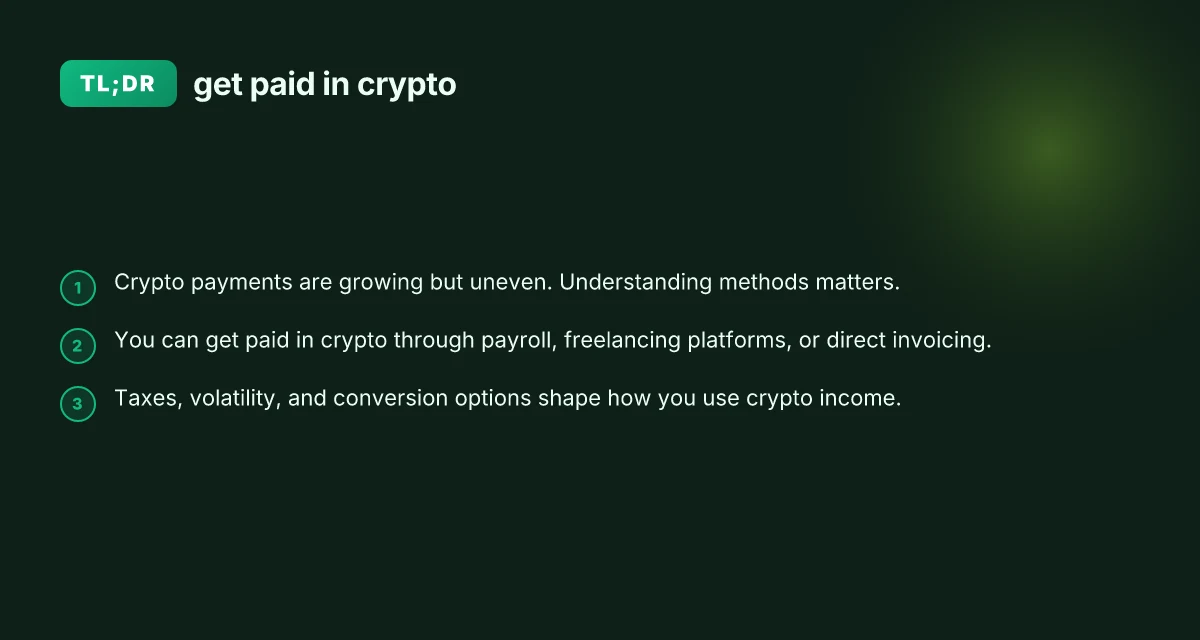
Getting paid in crypto means receiving compensation in digital currencies rather than traditional fiat money. Not all employers pay in crypto. There is a growing ecosystem of startups, freelancing platforms, and payroll services that support crypto wages, invoices, and payouts. This guide breaks down how it works, what to expect, and practical steps to start earning in crypto safely and effectively.

Comparison of payment methods when earning in crypto
| Method | Speed of payment | Fees | Tax implications | Volatility exposure | Ease of use |
|---|---|---|---|---|---|
| Crypto salary | Fast or immediate | Medium | Taxable event at receipt | High | Moderate |
| Crypto stipend/bonus | Quick to end of period | Low to medium | Taxable as earned | Moderate | Easy |
| Fiat salary converted to crypto | Fast after conversion | Medium to high (conversion) | Taxable as income; crypto gains later | Lower at receipt | Easy with payroll service |
| Stablecoin-based wage | Instant or near | Low | Taxable as income; minimal volatility | Low | Easy |
| Crypto mining/mined rewards | Real-time to wallet | Variable (electricity, fees) | Taxable as earned if recognized | Medium | Moderate |
| Freelance crypto payments | Upon invoice clearance | Low to medium | Taxable as income; capital gains later | Medium to high | Moderate |
Compiled November 2026; check the provider's site for current details.
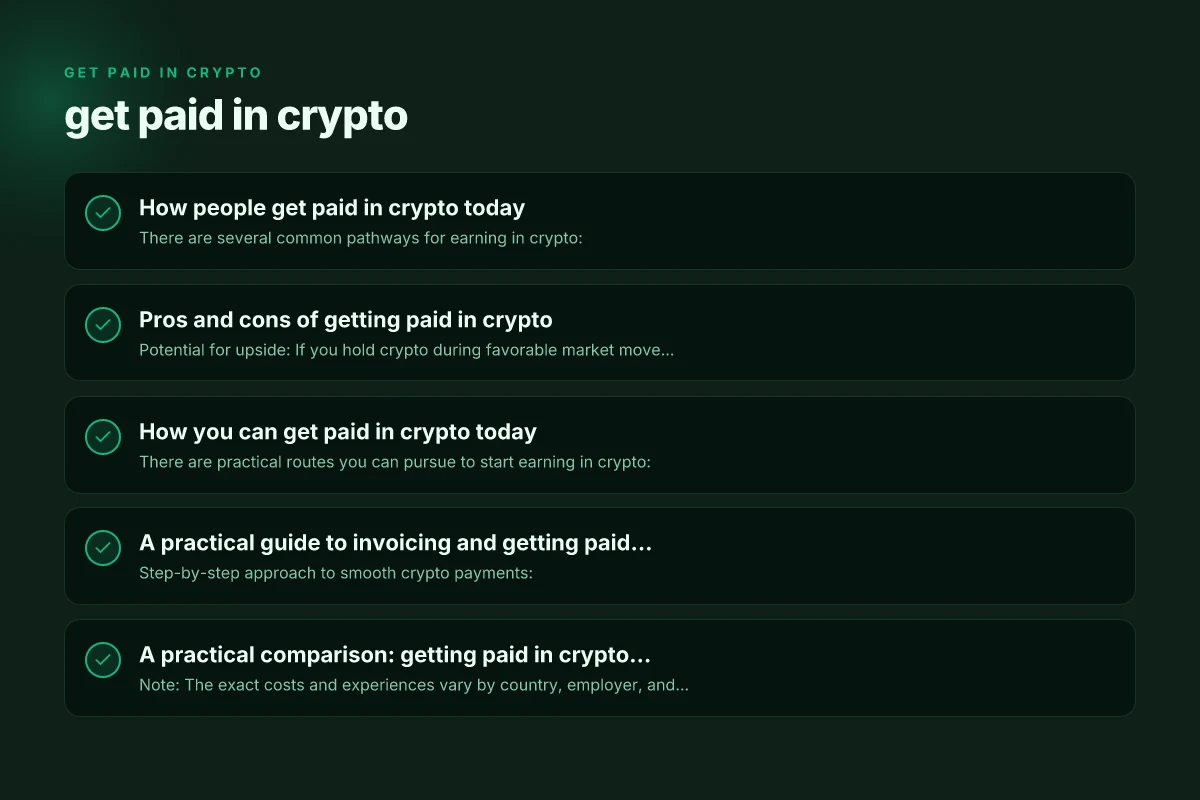
How people get paid in crypto today
There are several common pathways for earning in crypto:
- Direct payroll in crypto: Some companies, especially those in blockchain and Web3, offer payroll contributions in Bitcoin (BTC), Ethereum (ETH), or stablecoins. This tends to be rare outside crypto-focused firms but is increasingly seen in startups that base salary discussions on USD equivalents.
- Freelance invoicing in crypto: Freelancers and contractors can bill clients in crypto and use crypto-friendly invoicing tools or platforms that settle payments to wallets.
- Invoicing with conversion: Many workers are paid in dollars via traditional payroll but have the funds converted to crypto automatically or added to a crypto wallet. This is common when the employer uses a blockchain-enabled payroll service.
- Hybrid approaches: Some workers receive a portion in crypto (as a bonus or equity-like token) while the rest is paid in fiat, or they use crypto for specific projects or settlements.
Where you’ll see these options: crypto job boards, remote-work marketplaces, and decentralized freelancing platforms. Companies like Circle, Tether, and various blockchain startups sometimes advertise crypto-friendly roles, while platforms such as CryptoTask and other freelance marketplaces support crypto payments.
Pros and cons of getting paid in crypto
Pros
- Potential for upside: If you hold crypto during favorable market moves, your purchasing power can grow.
- Faster cross-border payments: Crypto can enable quick transfers without bank intermediaries.
- Tax and accounting flexibility: For some, crypto payroll aligns with specific business models or payroll optimization.
Cons
- Volatility risk: crypto prices can swing, affecting the USD value of your pay.
- Tax complexity: Tax treatment varies by jurisdiction and can be complicated (income recognition, capital gains on disposal).
- Involuntary conversion costs: Exchanges and wallets may charge fees. Spreads can affect amounts received.
- Cash-flow and budgeting: If you don’t convert, your day-to-day expenses may become unpredictable.
Pros and cons of getting paid in crypto Does adobe work on snapdragon processors
| Dimension | Pros | Cons |
|---|---|---|
| Financial | Potential upside from price appreciation | Price volatility risk |
| Convenience | Immediate cross-border payments | On-ramps/Off-ramps vary; learning curve |
| Taxation | Some jurisdictions offer favorable rules | Complex reporting; audit risk |
| Control | Self-custody for full control | Security responsibilities |
| Adoption | Growing ecosystem | Limited merchant acceptance |
Compiled November 2026; check the provider's site for current details.
How you can get paid in crypto today
There are practical routes you can pursue to start earning in crypto:
- Seek crypto-aware employers: Look for startups and companies in the blockchain space that advertise crypto payroll or crypto-based compensation.
- Use crypto-friendly freelancing platforms: Platforms that support crypto payments can streamline invoicing and wallet settlements.
- Use a crypto payroll or invoicing service: Services exist to convert or settle wages in crypto, sometimes with payroll tax support and compliance features.
- Invoices with on-chain settlement: Some providers allow freelancers to issue invoices that settle on-chain in BTC, ETH, or stablecoins.
- Hybrid solutions: Some workers receive a stablecoin salary, or a USD-denominated salary credited to a crypto wallet after on-chain settlement.
If you’re unsure about a role, ask these questions:
- Do you offer payment in crypto, and which currencies?
- Is there a preferred stablecoin or official wallet?
- How is the USD equivalent calculated and updated?
- What are the tax and reporting implications I should know?
A practical guide to invoicing and getting paid in crypto
Step-by-step approach to smooth crypto payments:
- Decide on your preferred currencies and wallets
- Choose BTC, ETH, or a stablecoin (e.g., USDC, USDT) based on risk tolerance and spend needs.
- Set up a reputable wallet (hardware wallets for security or reputable software wallets for convenience).
- Agree on a valuation method
- Most contracts specify a USD equivalent at the time of invoice or payment.
- Decide whether the client will pay in crypto at market rate, a pre-agreed rate, or a weekly/monthly rolling rate.
- Use reliable invoicing tools
- Invoicing platforms that support crypto can generate invoices and track settlements.
- If not using a platform, include wallet address, currency, and the exact amount to be transferred.
- Plan for security and compliance
- Use hardware wallets for large sums. Keep private keys secure.
- Keep detailed records of payments for taxes and audits.
- If you operate as a business, check local tax rules for crypto income.
- Convert or hold as needed
- You can hold crypto for longer-term opportunities or convert to fiat for daily expenses.
- Set up recurring conversions or use over-the-counter desks for larger sums to reduce slippage.
- Understand taxes and reporting
- Income from crypto is generally taxed as income when received. Capital gains rules apply on subsequent disposals or conversions.
- Maintain records of fair market value at receipt and any fees paid.
Practical guide to invoicing and getting paid in crypto Can nyxi hyperion 3 ultra connect to PC
| Step | Action | Key consideration | Suggested tool |
|---|---|---|---|
| 1 | Decide on currency | Crypto vs. fiat price lock | Invoice note: USD value + crypto price |
| 2 | Choose wallet | Hot vs. cold storage | Wallet app or hardware wallet |
| 3 | Issue invoice | Include crypto address | Invoicing platform supports crypto |
| 4 | Set terms | Payment window; fees | Net 7–30 days, fee split terms |
| 5 | Receive payment | Confirm receipt | Blockchain explorer check |
| 6 | Record for taxes | Value at receipt; cost basis later | Accounting software with crypto support |
| 7 | Convert or hold | Decide on treasury policy | Exchange or OTC desk |
Compiled November 2026; check the provider's site for current details.
A practical comparison: getting paid in crypto vs. in fiat
| Factor | Paid in crypto | Paid in fiat (USD/euro/etc.) |
|---|---|---|
| Currency exposure | High volatility risk; potential upside | Stable value; predictable budgeting |
| Fees | On-chain fees, wallet fees, exchange spreads | Payroll fees, banking fees, FX if cross-border |
| Tax reporting | Crypto income tax treatment, possible gains on disposal | Standard income/tax with regular payroll reporting |
| Liquidity needs | Requires conversion to spendable currency or stablecoins | Immediate spendability via fiat |
| Convenience | Dependent on wallet, wallet security, and conversion options | Familiar payroll systems and direct deposits |
Note: The exact costs and experiences vary by country, employer, and platform. Do not rely on these numbers as financial advice.
Practical tips to protect yourself
- Start small: If you’re new to crypto payroll, begin with a modest amount to learn the process.
- Choose reputable platforms and wallets: Research security features, user reviews, and regulatory compliance.
- Use stablecoins for salary when volatility is a concern: Stablecoins reduce price swings while you hold or convert.
- Diversify risk: Consider spreading income across fiat and crypto rather than converting all at once.
- Keep good records: Document every payment, the rate used, and transaction details for tax reporting.
- Be mindful of liquidity needs: If you rely on crypto for daily expenses, set up a plan to convert or hedge.
What the market looks like in 2026 and beyond
The landscape around get paid in crypto continues to evolve. Employers in the crypto and blockchain space are more comfortable with offering payroll options in digital currencies, while broader freelancing platforms increasingly support crypto payouts. Public sentiment and regulatory clarity will influence adoption rates, with some markets embracing crypto wages more quickly than others. Many workers still receive fiat salaries by default, with the crypto option offered as a benefit or pilot program. For freelancers especially, crypto payments can be an appealing route to bypass traditional payment rails, but they bring additional considerations around conversion, tax, and risk management.
The bottom line: should you get paid in crypto?
If you’re curious and prepared to manage volatility and tax considerations, getting paid in crypto can be a viable option, especially for:
- Freelancers or contractors who do business with blockchain companies or crypto-focused clients.
- Employees at startups or firms that publish crypto payroll offerings and have clear policies.
- Individuals who want to build a crypto wallet and learn to manage digital assets.
However, for many workers, a fiat salary remains the most predictable and tax-friendly option, with crypto used for investment or optional supplementary income. Brinker International Payroll Company LP and Chili's
Recommendation: If you’re considering getting paid in crypto, start by testing the waters with a small portion of your income, or pilot a salary in a stablecoin to reduce volatility. Use reputable platforms, set clear valuation rules, and keep thorough tax records. If you’re unsure, consult a tax professional or financial advisor who understands crypto in your jurisdiction.
If you’d like, I can tailor this guide to your country’s tax rules, suggest specific platforms that support crypto payroll or invoicing in your region, or draft a sample crypto invoice you can use to discuss with a client.