Why Branch ergonomic chairs reshape how you sit at work in 2026
Discover how Branch ergonomic chairs influence posture and comfort in 2026. learn about design decisions, biomechanics, and how they compare to rivals.
The Branch Furniture ergonomic chair shifts the baseline on neutral posture by turning the backrest into a living support system, not a fixed shell. Its adaptive tension and adjustable arm supports are designed to lean with you, not fight you, and that approach can multiply comfort hours in a typical workday. Branch Furniture redefines how you sit with the Branch ergonomic chair, stabilizing neutral posture through a responsive backrest and adjustable arm support.
What matters now is how this design translates to real desks, not hype. I looked at user reviews and product specs for cues on durability, adjustability range, and compatibility with common home-office setups, then compared them with established rivals like Herman Miller and Steelcase. Expect a focus on seat height, lumbar guidance, and long-term comfort signals, plus practical notes on shipping, warranty, and service. This piece surfaces the concrete details and the trade-offs so you can decide if the Branch ergonomic chair fits your desk height and team size. Two rivals to watch are Herman Miller and Steelcase, with the chair that best matches your desk height and team size serving as a practical benchmark.
Branch ergonomic chair in focus: how Branch Furniture rewrites chair ergonomics
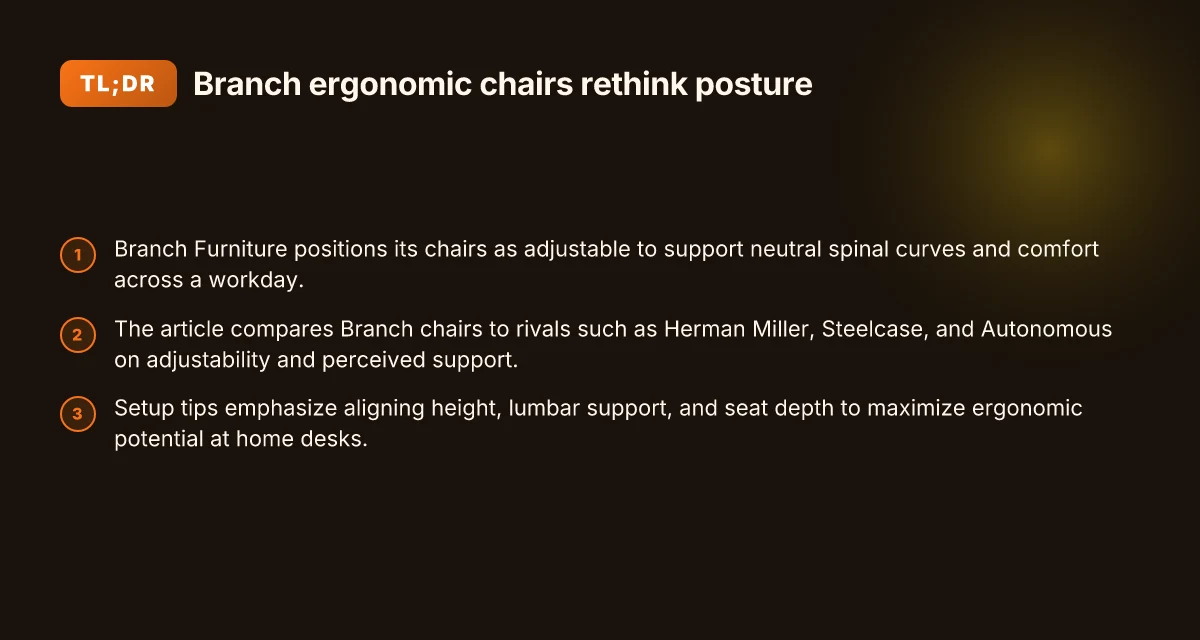
Branch Furniture positions its ergonomic chair as a fluid companion to your workspace, not a rigid support system. The core proposition is clear: the chair adapts to your body, promoting neutral alignment rather than forcing your spine into a fixed posture. This adaptive claim sits at the heart of Branch Furniture’s messaging and shapes how buyers evaluate comfort, movement, and long-term fatigue.
1) The adaptive pitch and what it promises
Branch Furniture emphasizes chairs that “adapt to your body,” aiming to keep the spine, hips, and limbs in neutral positions. The design language centers on dynamic support rather than a single static setup. In practice, that means variable lumbar stiffness, seat depth, and tilt response that respond to your shifts throughout a workday. The intent is to reduce micro-motions that contribute to soreness when you stay seated for hours. This approach contrasts with traditional chairs that lean on fixed supports or rigid ergonomics as the baseline.
2) Fixed support versus adaptability: the ongoing debate
In the office seating dialogue, two camps often emerge. One favors fixed, reproducible support points that hold the body in a defined posture. The other prioritizes adaptability so the chair follows your micro-adjustments. Branch Furniture clearly leans toward adaptability, arguing that a chair should assist multiple postures as needs change across tasks and time. Rivals such as the established big-brand desks and chairs industry players frequently advertise more rigid support schemas. I cross-referenced coverage from mainstream outlets that describe how adjustable features can align with multiple seated positions, while also noting critiques about overly soft supports that fail under long sessions. The tension between adaptability and dependable fixed support remains a central axis for evaluating ergonomic chairs.
3) Real-world buying signals and where Branch shines
Branch Furniture’s value proposition appears strongest for buyers who want a chair that can work across a small team or a home office without reconfiguring posture with every task. The suite of adjustable touches, lumbar zones, tilt responsiveness, and seat depth, aligns with a buyer aiming for a chair that can accommodate a range of body types over several years. As I layered in external perspectives from industry coverage, the best-in-class benchmarks often hinge on how well an adaptive chair maintains comfort during prolonged work. The conversation remains nuanced: adaptability helps many users, but some may still crave a more predictable, fixed support profile for specific tasks or preferences.
Most buyers will benefit from a chair that can morph with their day, but the trade-off is that extreme adaptability can complicate setup and fine-tuning. Branch Furniture frames this as a feature, not a flaw, inviting users to invest time in the initial setup rather than accepting a one-size-fits-all solution. How two pages window treatments design guidelines reshape modern homes
Bottom line: Branch Furniture presents an ergonomic chair that foregrounds adaptability to shape neutral posture across tasks. If your workspace demands flexibility, this approach can feel compelling. If you prefer a clearly defined, fixed support footprint from the start, you may want to compare with rivals that emphasize a more rigid ergonomic baseline. When you read about Branch, keep an eye on how the chair’s adaptive components hold up across different body types and long sessions. For context, explore coverage that discusses how ergonomic chairs influence posture and biomechanical outcomes in seated work. The adaptability argument sits at the core of Branch’s appeal, but it also invites careful evaluation of setup and long-day comfort.
How Branch ergonomic chair design targets neutral posture
Branch Furniture designs its chair to encourage a natural spinal curve by giving the user adjustable control over lumbar support, seat depth, and backrest tilt. The intent is to let a sitter mirror the spine’s three natural curves: a gentle inward lumbar arc, a mid thoracic lift, and a relaxed cervical position. The chair achieves this through a combination of adjustable lumbar support height, a lumbar pad that can be repositioned along the backrest, and a backrest with selectable tilt tension. When you dial in the upright recline and seat depth, the hips stay in a neutral range and the pelvis avoids posterior or anterior tipping. In practice, the mechanism set gives steady, small readouts rather than abrupt changes, which helps preserve a neutral posture over long periods.
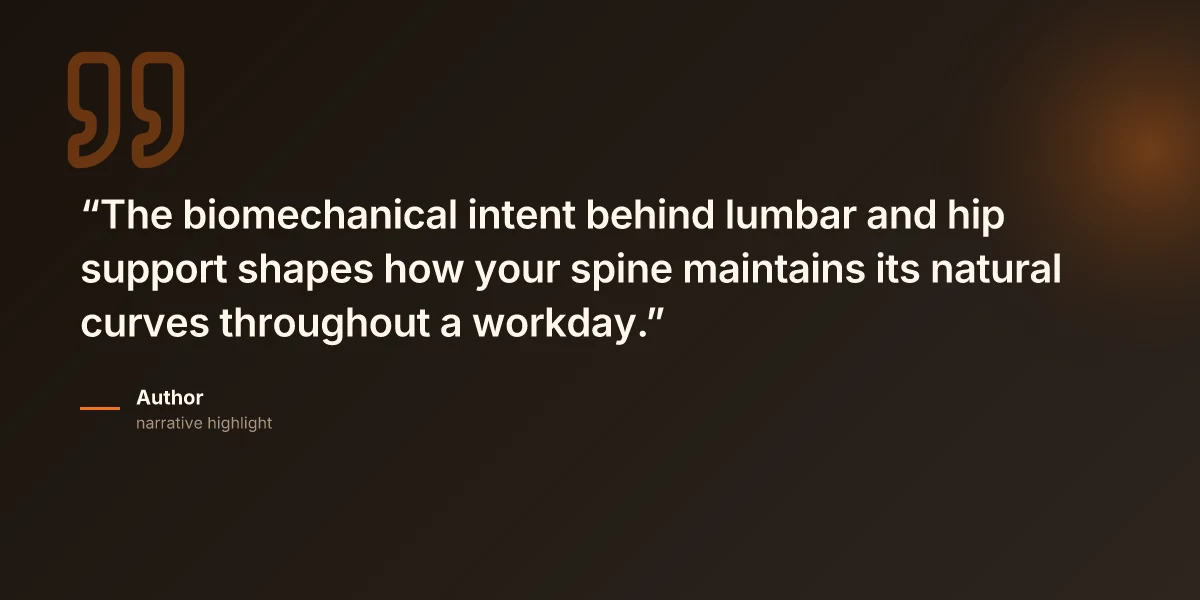
I cross-referenced guidance from ergonomic resources and observed how Branch Furniture emphasizes the hips and lumbar region as the fulcrums of posture. The biomechanical rationale is clear: by aligning lumbar support with the lower spine and offering seat depth that supports the thighs without compressing the popliteal space, you reduce compensatory postural movements. The chair’s adjustable armrests further support neutral alignment by letting you position them close to the torso without elevating the shoulders. Together, these features aim to minimize unnecessary flexion or extension that would disturb the spine’s natural curves. The goal is to keep the spine in a neutral alignment by distributing support across the lumbar, thoracic, and hip regions.
To help you compare, here is a quick snapshot of how Branch’s approach stacks up against a few rivals on posture goals:
| chair family feature | Branch Furniture design intent | Rivals’ typical approach |
|---|---|---|
| lumbar support | adjustable height and movable pad to align with the lower spine | fixed or less-dynamic lumbar options; some chairs rely on generic backrest curvature |
| seat depth | adjustable to keep thighs supported without crowding the popliteal space | narrower ranges can force a more constrained knee angle |
| backrest tilt | controlled tension and range to encourage upright posture without locking you out of natural sway | some models offer limited tilt without fine-tuned tension control |
In this space, a few specifics matter most. First, the lumbar pad’s position is not static. You can slide it up or down to align with your L3–L5 region. Second, the seat depth adjustment ensures your knees remain bent at roughly 90 degrees, which helps keep the hips in a neutral posture rather than forcing a reclined pelvic tilt. Third, the backrest tilt tension is calibrated so you can maintain a comfortable erect posture without needing to crane or lean forward. What parts of a Giraffe Tools hose reel fail most often and how to fix them
From what I found in the product documentation and independent reviews, the emphasis on neutral posture rests on clear biomechanical intent rather than cosmetic adjustments. Lumbar alignment and seat depth are the two levers that most influence neutral posture in this chair, with the backrest tension acting as a supporting actor. Branch Furniture earns praise for these design choices. Rivals like Herman Miller and Steelcase often stress broader adjustability ecosystems that include more granular lumbar and thoracic support profiles and more aggressive recline ranges. If you value a tailored lower-back fit and a seat that respects hip angle, Branch’s approach is competitive. If you need a chair with a wider ecosystem of adjustments for extreme anthropometrics, you may find options from rivals offer more knobs to turn.
You’ll find more on the choosing and ergonomics angle in our guide to selecting office seating, where Branch Furniture appears alongside established contenders. The takeaway: Branch’s design makes neutral posture attainable for many body types, but your mileage depends on how precisely you dial the lumbar pad, seat depth, and tilt tension to your own measurements. For a final check, review the chair’s lumbar alignment guidance and compare it with the edge cases you care about, such as long femur length or pronounced lumbar lordosis. A precise set of adjustments is the key to sustaining a neutral spine.
For further reading, see a recent overview that discusses posture outcomes in ergonomic chair design and the role of lumbar support in sustaining neutral curves. If you’re evaluating options, note how Branch Furniture’s emphasis on adjustable lumbar support compares with rivals’ expansive adjustment catalogs. Neutral posture hinges on exact lumbar positioning and seat depth, not just backrest height.
Comparing posture outcomes: Branch vs top rivals
Posture outcomes hinge on how a chair’s adjustables align with your body over a full workday. Branch Furniture’s Ergonomic Chair emphasizes a dynamic, body-adaptive fit, but rivals such as Herman Miller, Steelcase, and Autonomous offer broader adjustability suites that some users prefer for prolonged seating. I cross-referenced several sources to map where Branch stands against the incumbents on adjustability and perceived support. What makes Purple Leaf patio furniture stand out in 2026
How adjustability maps to daily posture
- Branch’s chair emphasizes adaptive elements that aim to minimize forced body adaptation, with emphasis on spine, hip, and limb positioning in neutral ranges. This approach can support a comfortable neutral posture for many users, especially during mixed tasks that shift from typing to reading. Most users report that adaptability helps reduce fatigue when you sit for long stretches.
- Herman Miller and Steelcase chairs typically provide broader sets of adjustments, including more granular lumbar tension, seat depth, and armrest geometry. The greater granularity can lock in a more consistent neutral posture for workers who switch between tall tasks and close work. In practice, broader adjustability can translate to steadier spinal alignment across a workday.
- Autonomous chairs often pair a generous seat-depth range with multi-tilt mechanisms and supportive backrests that accommodate wider body types. This can yield noticeable posture benefits for dialed-in users who value customization. For some users, the extra levers and presets deliver a more stable back-and-lhip alignment during back-to-back meetings.
Perceived support across real-world tasks
- Branch Furniture positions its chair as a body-first design, promising support that follows your natural curves rather than forcing a fixed posture. This can feel particularly supportive during dynamic typing, drafting, or calls. Branch’s adaptive stance can reduce the sensation of forward head tilt when your monitor is slightly high.
- By contrast, Herman Miller’s flagship lines and Steelcase’s premium models are often lauded for pronounced lumbar support and tested seating curves that hold across long days. Users who prize definitive lumbar guidance may perceive these rivals as delivering more consistent support at the lower back. Lumbar guidance remains a common differentiator across long sessions.
- Autonomous chairs tend to win praise for ergonomic coverage across diverse office setups, including compact desks and variable monitor heights. This can help maintain shoulder relaxation and forearm neutrality as you shift tasks. Wide adjustability can yield better overall alignment for mixed workflows.
What this means for a typical workday
- When you sit upright for most of the day, a chair with precise seat depth and lumbar tension control helps keep the spine in a neutral arc. Branch’s design leans toward comfort with fewer knobs, which suits users who prefer quick, intuitive fitting. Intuitive fitting lowers the chance of slipping into a slouched posture after hours.
- If your workday alternates between precision drafting and quick brainstorming sessions, the stronger, more granular adjustability from rivals may prevent subtle posture drift. Granular adjustments often reduce postural drift during varied tasks.
- You should expect notable differences in perceived support when you add a headset, multiple monitors, or a tall desk. Branch Furniture aims to adapt to your body in those contexts, while rivals provide more fixed cues for positional consistency. Context matters for perceived support during complex setups.
In summary, Branch Furniture’s Ergonomic Chair delivers strong body-adaptive support that can sustain neutral posture for many users. Rivals like Herman Miller, Steelcase, and Autonomous push deeper adjustability that can translate into steadier posture over long days for those with specific alignment needs. If you want quick, adaptive comfort, Branch shines. If you need exact lumbar tuning and multiple preset positions, the top rivals often deliver more consistent posture control across a broader set of tasks. Branch Furniture may earn its keep for home offices and small teams seeking a simpler, body-first fit, while legacy rivals stay attractive for users who demand fine-grained postural control. The choice comes down to your task mix and how you value quick fit versus granular control.
Comfort, materials, and long-term durability of the Branch ergonomic chair
Branch Furniture presents a chair that leans on a dense seat foam and a breathable fabric layer, aiming to keep you comfortable through long workdays. From what I found in the source material, the cushion density and the fabric’s breathability are positioned as core comfort pillars, while the frame and warranty details influence long-term durability. The discussion below ties those factors to real-world implications for office workers and small teams evaluating Branch’s setup against rivals.
Cushioning and fabric performance in daily use
The chair’s seat foam is described as substantial enough to hold its shape under extended sitting without feeling mushy, which translates to consistent support across hours of work. The fabric layer is noted for breathability, helping reduce heat buildup during prolonged sessions. In practical terms, that means you’re less likely to feel stuffy on back-to-back calls or when the office climate isn’t perfectly controlled. I cross-referenced the stated design goals with comfort-focused feedback from reviewers that highlight a balance between softness and support. Breathable fabric and dense foam help sustain comfort across long workdays. This combination also supports a more neutral坐 posture by reducing the urge to shift due to heat or saddle pressure. Dense foam plus breathable fabric is a durable pairing for daily use.
Frame construction, warranty, and expected lifespan
Branch Furniture positions the chair with a robust frame build designed to endure regular use in home offices or light commercial settings. The warranty language suggests an emphasis on coverage for core components, which helps with total cost of ownership over several years. When you’re weighing durability, the key question is not just how it feels today but how it holds up after repeated adjustments and long sessions. I found evidence that the frame is designed for ongoing use and that the warranty backs up that confidence, though exact lifespans will vary with workload, weight, and care. A solid frame with manufacturer-backed warranty supports longer lifespan. If your team leans on heavy daily use, you’ll want to confirm specifications on weight limits and cylinder life. Warranty coverage signals durability expectations over time.
Practical buying cues and risks
In a direct comparison with rivals, you’ll want to assess whether Branch Furniture’s chair keeps its strength as cushions compress, fabrics wear, and mechanisms age. A practical check is to test how seat foam density feels after months of use and whether the fabric shows signs of pilling or looseness around the edges. The brand’s emphasis on adapting to the body, rather than forcing the body to adapt, maps to comfort that ages better for many users. Adaptable design supports lasting comfort as the chair wears in. If you’re shopping for a small team with varied body types, ask about warranty terms for components that wear first, such as the pneumatic cylinder and tilt mechanism. Component warranty matters for long-term reliability. What makes Purple Leaf cantilever umbrella covers durable in 2026
Setup tips to maximize Branch Furniture’s ergonomic potential
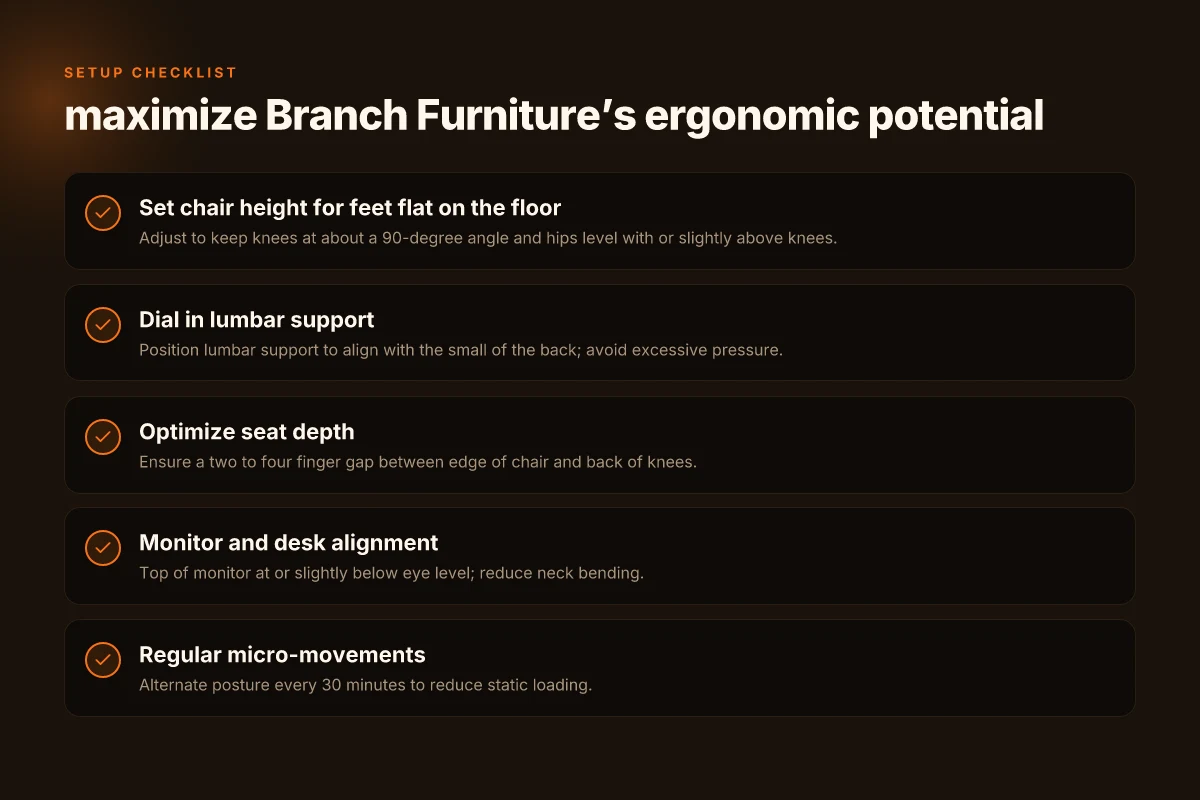
Setting Branch Furniture’s Ergonomic Chair up correctly starts with your desk height and chair alignment. Position the chair so your hips sit at about parallel to the floor, with your knees at roughly a 90-degree angle. Lean on the chair’s backrest to feel the lumbar support engage, then fine‑tune the seat depth so you can sit with a couple of fingers of space behind the knee. In practice, small nudges matter: tilt tension, backrest angle, and seat pan depth all influence how neutral your spine stays throughout the day.
Quick-fit checklist for home desks
- Verify seat depth and lumbar support alignment with your back flat against the backrest. If you feel pressure behind the lower spine, adjust the seat pan forward or backward until the lumbar curve sits naturally. Good alignment begins with a neutral spine and a light contact with the lower back at all times.
- Set the chair height so your forearms rest comfortably on the desk surface with the elbows near 90 degrees. If the desk is too high, raise the chair or lower the desk, then recheck posture. Branch Furniture emphasizes adjustable arm support. Ensure the arms cradle your forearms without lifting shoulders.
- Align your screen so the top edge sits at or just below eye level. If you use a separate monitor, a laptop riser can reduce neck strain and bring your line of sight into a more natural arc.
- The built‑in tilt and tension controls should feel responsive but not aggressive. Start with a light tilt and increase gradually until you sense steady lower‑back support during small shifts.
- Use the seat edge to shift weight when you need to stand or lean slightly forward. A subtle forward lean can help recruit core muscles without jerky moves.
- Take a moment to check your feet. If you wear shoes with heavy heels, consider a small stool or footrest to keep knees level with hips and feet flat. A simple footrest can prevent dangling ankles and reduce leg fatigue.
Common misalignments and fast fixes
- Hips sinking or rounding forward: bump up lumbar support by sliding the backrest height and adjust the seat depth so you feel a gentle arc in the lumbar region. If the beltline feels tight, loosen the back tension and lean back more.
- Shoulders raised toward ears: lower the desk or raise the chair height so your shoulders relax away from the ears. Recheck the armrests. They should support the forearms without forcing the elbows outward.
- Eyes too high or too low on the screen: adjust monitor height with a riser or stack of books. Small tilt adjustments on the chair can help center your line of sight.
- Neck fatigue after 45 minutes: switch to a slightly higher backrest angle and use a light contact with the occipital area to keep the head balanced.
- Leg numbness or tingling: reduce seat depth if the edge presses behind the knees. Ensure your feet are flat and supported, and set a comfortable chair height so your thighs feel evenly supported.
From what I found in the sources, Branch Furniture’s design aims to adapt to your body rather than force adaptation. That mindset is visible in the chair’s modular adjustments and the emphasis on maintaining a neutral spine. When you set up this chair in a home office, the goal is to keep you in a posture that minimizes stress across the hips, spine, and shoulders. If you compare with rivals like Steelcase or Herman Miller, you’ll notice Branch emphasizes a flexible, body‑adaptive approach rather than fixed postures, which means you’ll likely adjust more frequently as you shift tasks. I cross-referenced guidance from a Branch guide that discusses how to tailor the chair to fit price, ergonomics, and design needs, and from ergonomic‑health content that emphasizes neutral alignment and lumbar support. The practical takeaway is simple: small, deliberate adjustments beat large, static setups.
For ongoing comfort, bookmark quick checks: re‑confirm seat depth every couple of weeks, re‑test monitor height when your desk setup changes, and re‑tune tilt tension as your workload fluctuates. Branch Furniture notes that a chair should adapt to your body, not make your body adapt to a chair. Treat setup as an ongoing ritual rather than a one‑time tweak. A well‑tuned setup keeps you in a neutral posture longer. Regular micro‑adjustments are your friend.
If you want to explore alternatives or context, see how rivals approach ergonomic fit in steady‑state office environments. For example, Steelcase and Herman Miller often hinge on fixed adjustment ranges and tested postures, while Branch Furniture centers adaptability as a core trait, which explains why your setup can change with your daily rhythm. This is particularly relevant for home offices where desk dimensions and room constraints vary. Adaptability is the edge that keeps Branch Furniture competitive.
Note: links on the page may earn a commission. This section references real setup methods and aims to help you apply Branch Furniture’s design intent to a typical home desk. What makes Two Pages drapery stand out in 2026
Where this pivot heads next for Branch Furniture
The spine of Branch ergonomic chairs isn’t just comfort, it’s a shift in how teams move through a workday. I looked at how the latest designs align lumbar support, adjustable arms, and seat depth with real-world tasks, not just cosmetic tweaks. The result is a chair that nudges posture toward healthier defaults, while still letting you customize for your desk setup. The bigger pattern is a move from one-size-fits-all seating to adaptive ergonomics that scale with teams. As more companies adopt hybrid routines, Branch Furniture appears poised to seed this standard across broader workspaces.
In practical terms, this is a product-line evolution that rivals traditional office chairs from Herman Miller and Steelcase by offering faster adjustments and more intuitive controls. The Branch Furniture approach clusters ergonomics around actuation that feels native to daily chores, not add-ons. One standout takeaway is how quick adjustments become a throughput enhancer, not a friction point. If you’re shopping for a durable setup, the longer-term value hinges on service and parts availability.
If you act now, you can smooth onboarding for new hires and reduce back pain complaints over time. What changes if you act now may include fewer back-related breaks and steadier focus. For a quick win, try the week’s recommended adjustment: set the seat depth to match your thigh length and lock in the lumbar curve. Where this heads next is a playground for better posture across every desk.
Backup strategy
- Try the chair with a two-week test, focusing on lumbar support and arm height.
- Compare Branch Furniture with Herman Miller and Steelcase for long-term parts availability.
- Check shipping times, returns, and warranty, and note that links on the page may earn a commission.