VPN does nit work at the office
A practical guide to VPNs at work, including why office networks block VPNs and how to use ZoogVPN responsibly.
In many office environments, VPNs either don’t work or are explicitly blocked on company Wi‑Fi. This guide explains why that happens, what you can do next, and how ZoogVPN can fit into a compliant workflow when permitted by your IT team.

Why VPNs often fail on office networks
- Network controls: Corporate Wi‑Fi and firewall configurations frequently block VPN protocols or specific ports that VPNs rely on.
- Security policies: Companies restrict third‑party VPNs to protect data, manage bandwidth, and prevent unauthorized access to internal resources.
- Detection and logging: VPN traffic may be flagged by network monitoring tools, leading to restricted or blocked use.
- Shared devices: In many offices, devices are managed by IT with limited ability to install or run non‑approved software.
If your VPN simply doesn’t connect at work, it’s usually not a failure of your device alone, it’s the network policies in play.
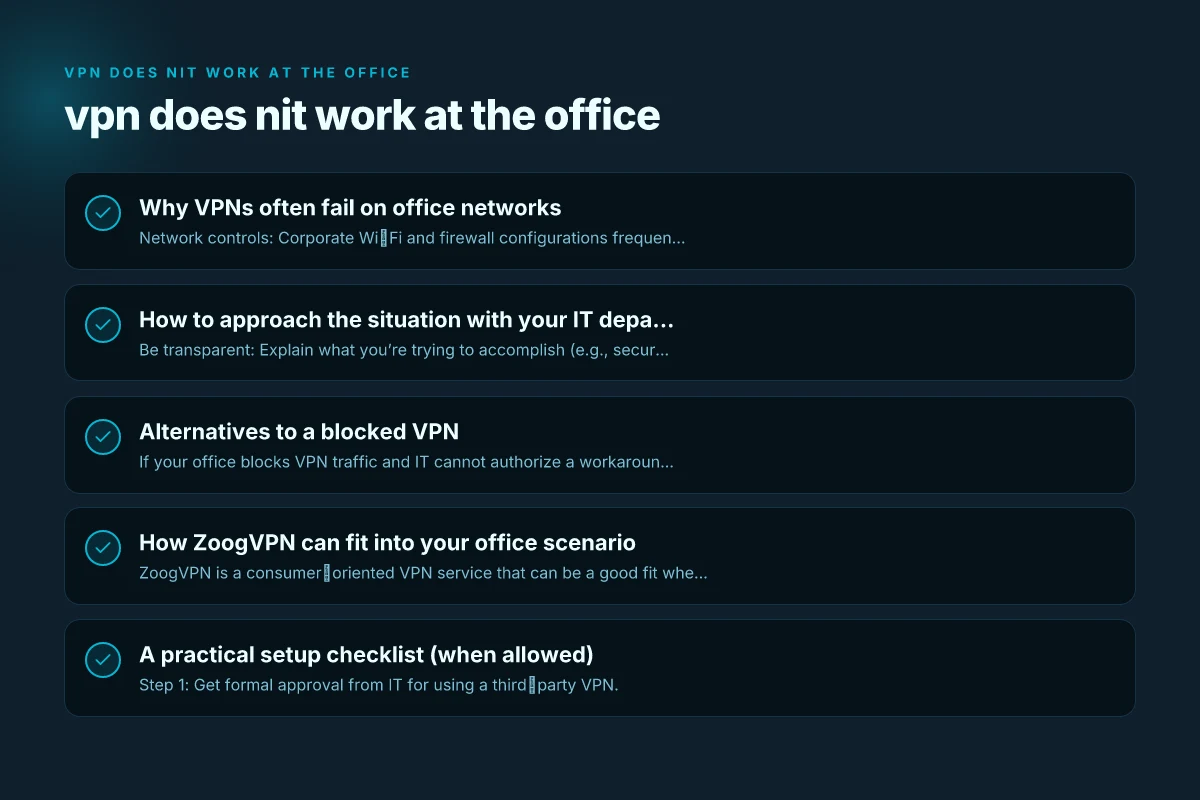
How to approach the situation with your IT department
- Be transparent: Explain what you’re trying to accomplish (e.g., secure remote access, privacy, or accessing approved work resources from home).
- Ask for guidance: Inquire if a company‑approved VPN solution exists or if your use case can be accommodated under policy.
- Request a sanctioned method: Some companies offer an enterprise VPN, a secure remote desktop, or a sandboxed approach that keeps data on approved paths.
- Clarify compliance: Ensure any solution aligns with data protection, HIPAA, corporate governance, or other applicable rules.
- Get documentation: Request written guidance or a formal approval to avoid policy violations.
If IT approves a VPN, they’ll usually provide setup instructions, required certificates, and any restrictions you must follow.
Alternatives to a blocked VPN
If your office blocks VPN traffic and IT cannot authorize a workaround, consider these compliant options:
- Remote access to approved services: Use a secure, company‑provided portal or remote desktop to access needed apps without routing all traffic through a personal VPN.
- Split tunneling (where allowed): Some enterprise VPNs support split tunneling, sending only work traffic through the VPN while leaving other traffic on the local network. This requires IT approval.
- Cloud‑based solutions: Access resources via approved cloud services with built‑in access controls and auditing.
- Personal device policies: If permitted, use a company‑provided device or a personal device within a clearly defined BYOD policy, avoiding sensitive data on non‑approved devices.
Note: Always confirm what is permitted by your employer before attempting any workaround.
How ZoogVPN can fit into your office scenario
ZoogVPN is a consumer‑oriented VPN service that can be a good fit when an employer approves its use, or for personal tasks outside the office. If your IT department allows the use of ZoogVPN for remote access or personal privacy on off‑hours networks, here are practical tips: Why your VPN won't connect at school
- Confirm eligibility: Check with IT whether third‑party consumer VPNs are permitted for your role or if only company VPNs are allowed.
- Use the right protocol: ZoogVPN supports common protocols (such as OpenVPN, WireGuard/WG) that balance security and performance. Your setup instructions should specify which to use.
- Verify encryption and leaks: Ensure you enable strong encryption and DNS/ WebRTC leak protection to avoid exposing traffic.
- Respect data boundaries: Do not route sensitive corporate data through personal VPN services unless explicitly approved. Keep work on sanctioned channels.
- Monitor performance: If you experience slow connections, try a different server location, or check for bandwidth policies from IT.
If IT does not permit ZoogVPN or any consumer VPN, abstain from attempting to bypass controls and instead pursue an IT-approved solution.
A practical setup checklist (when allowed)
- Step 1: Get formal approval from IT for using a third‑party VPN.
- Step 2: Obtain any required configuration files or certificates from IT or ZoogVPN, as applicable.
- Step 3: Install the VPN client (ZoogVPN app or a manual OpenVPN profile) on your device.
- Step 4: Configure the VPN with the recommended server location and protocol per IT guidance.
- Step 5: Test access to both work resources (if permitted) and non‑work sites to confirm proper operation.
- Step 6: Enable security features (auto‑kill switch, DNS leak protection) if available.
- Step 7: Keep logs minimal in line with policy, and report any issues to IT promptly.
Common questions about using VPNs at work
- Why doesn't my VPN work at work? Many offices block VPN protocols or specific ports. IT policies may disallow non‑approved VPNs on corporate networks.
- Can my employer tell if I’m using a VPN? Yes. Network monitoring can detect VPN traffic, so it’s best to use only sanctioned solutions and follow IT guidance.
- Does Wi‑Fi have to be off for VPN to work? Not necessarily. VPNs can work over your office Wi‑Fi if the network allows the VPN protocol and ports. Otherwise, IT policy governs access.
- Is using a VPN HIPAA compliant? It depends on the VPN provider, configuration, and how it’s used. For work‑related data, you should follow your organization’s compliance requirements and use approved solutions.
Quick comparison: ZoogVPN vs. a typical workplace VPN (when you have IT approval)
| Factor | ZoogVPN (consumer) | Enterprise/Work‑provided VPN |
|---|---|---|
| Approval required | Typically needs IT approval for workplace use | Usually integrated into IT policy and onboarding |
| Protocols | OpenVPN, WireGuard, etc. | Often IPSec or proprietary enterprise clients |
| Management | User‑driven setup, personal accounts | Centralized management, certificates, access control |
| Privacy on non‑work traffic | Individual privacy protection; follow policy | Privacy governed by company policy and logs |
| Support | Customer support from ZoogVPN | IT support for the corporate VPN, with SLA expectations |
Note: This table illustrates general differences. Always align with your company’s policy and IT guidance.
Final recommendation
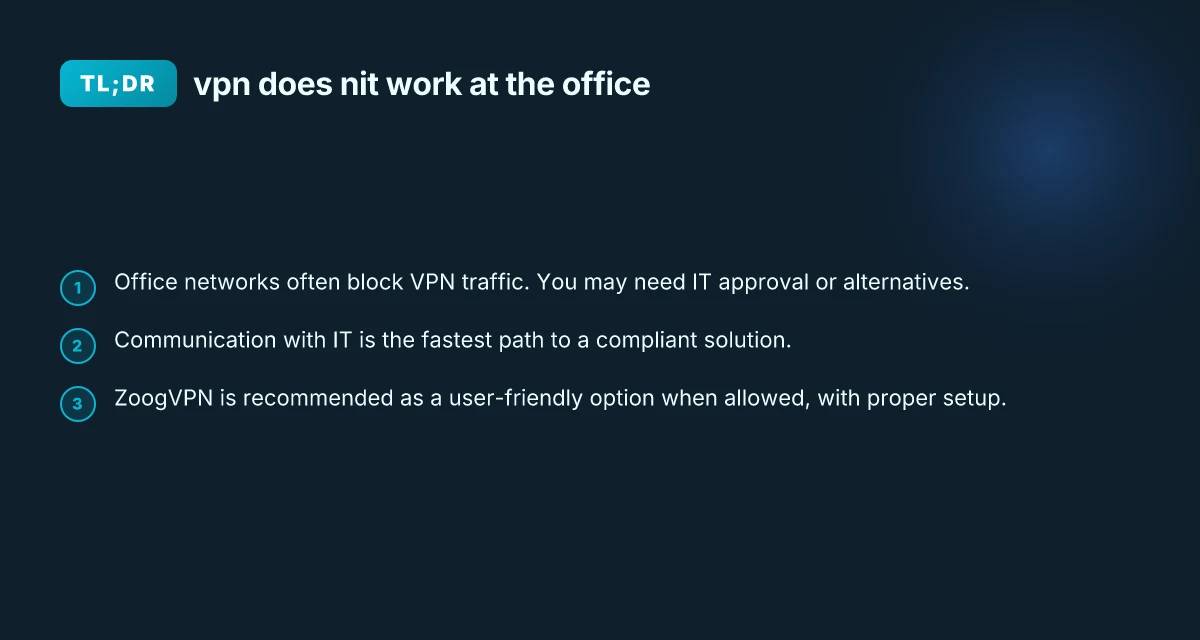
If your goal is to access work resources securely and compliantly, the fastest path is to talk to your IT department. They can tell you what is allowed, provide the appropriate tools, and set up a solution that meets security and regulatory needs. If your IT department does approve a consumer VPN like ZoogVPN for personal use or specific remote tasks, follow their setup instructions precisely, enable strong protections, and avoid using the VPN to bypass security controls.
When used with IT approval, ZoogVPN can be a practical option for personal privacy and remote access in off‑hours or on non‑work networks. However, never circumvent corporate policy or IT controls. By coordinating with your IT team and choosing a sanctioned approach, you can stay secure, compliant, and productive.
| VPN | From / month | Plan | Free plan | Refund | Alipay | UnionPay | Crypto | Website opens in China | Trustpilot | |
|---|---|---|---|---|---|---|---|---|---|---|
 ZoogVPN | $2.49/mo | 27 months: $59.99 | Yes | 7 days | ✓ | ✓ | ✓ | ✓ | ✓ Yes (2.5 s) | 4.2/5 (195 reviews) |
 NordVPN | $3.49/mo | 27 months: $94.23 | No | 30 days | ? | ✗ | ✓ | ✓ | ✗ Blocked | 4.2/5 (51,628 reviews) |
 ExpressVPN | $3.00/mo | 28 months: $84 | No | 30 days | ✗ | ✗ | ✓ | ✗ | ✗ Blocked | 4.4/5 (29,706 reviews) |
 Surfshark | See site | See site | No | 30 days | ✗ | ✗ | ✗ | ✓ | ✗ Blocked | 4.3/5 (31,823 reviews) |
 Proton VPN | $2.99/mo | 12 months: $35.88 | Yes | 30 days | ✗ | ✗ | ✗ | ✓ | ✓ Yes (2.5 s) | 2.1/5 (1,040 reviews) |
 Astrill VPN | $12.50/mo | 24 months: $300 | No | See site | ✗ | ✗ | ✗ | ✓ | ✗ Blocked | 1.3/5 (110 reviews) |
 Private Internet Access | $2.03/mo | 40 months: $81.2 | No | 30 days | ✗ | ✗ | ✗ | ✗ | ✗ Blocked | 4.2/5 (11,033 reviews) |
 CyberGhost | $2.19/mo | 28 months: $61.32 | No | 45 days | ✗ | ✗ | ✗ | ✓ | ✗ Blocked | 4.0/5 (24,178 reviews) |
 PureVPN | $1.69/mo | 60 months: $101.55 | No | 31 days | ? | ✗ | ✗ | ✓ | ✓ Yes (2.6 s) | 4.4/5 (17,994 reviews) |
 AdGuard VPN | $2.99/mo | 24 months: $71.76 | Yes | 30 days | ✓ | ✗ | ✓ | ✓ | Official site blocked; our special link opens (2.3 s) | 4.3/5 (290 reviews) |
 Mullvad | $5.61/mo | €5/mo | No | 14 days | ✗ | ✗ | ✗ | ✓ | ✗ Blocked | 3.2/5 (192 reviews) |
 Windscribe | $5.75/mo | 12 months: $69 | Yes | See site | ✗ | ✗ | ✗ | ✓ | ✗ Blocked | 4.7/5 (13,355 reviews) |
 StrongVPN | See site | See site | No | 30 days | ✓ | ✗ | ✗ | ✗ | ✗ Blocked | 4.4/5 (2,695 reviews) |
 LightXtreme 闪连 | $7.08/mo | 12 months: $84.99 | Yes | 30 days | ✓ | ✓ | ✓ | ✓ | ✓ Yes (2.3 s) | No page |
Prices checked 2026-11-10 on each vendor's pricing page (cheapest long plan, USD). Check the vendor's checkout for the final price.
Payment methods checked 2026-11-10 on each vendor's payment pages: all 14 take cards and PayPal; ✗ = not listed, ? = the vendor's own pages disagree.
China access: whether the official website opens from mainland China networks (tests the website only, not the VPN connection). Last checked 2026-11-11 04:07 Beijing time.
Trustpilot score and review count checked 2026-11-10.