Organization structure and the payroll department: shaping efficient payroll operations
A practical guide to how organization structure affects payroll departments and payroll processes.
Payroll is more than processing checks. It is a critical control point in an organization. The way you design the organization structure around the payroll department influences accuracy, compliance, timeliness, and employee trust. When payroll sits in isolation or is buried under a miscellaneous accounting function, errors rise and compliance risk grows. A deliberate structure that integrates payroll with Human Resources, Finance, and Compliance creates smoother workflows, better data integrity, and a scalable path as the company grows.

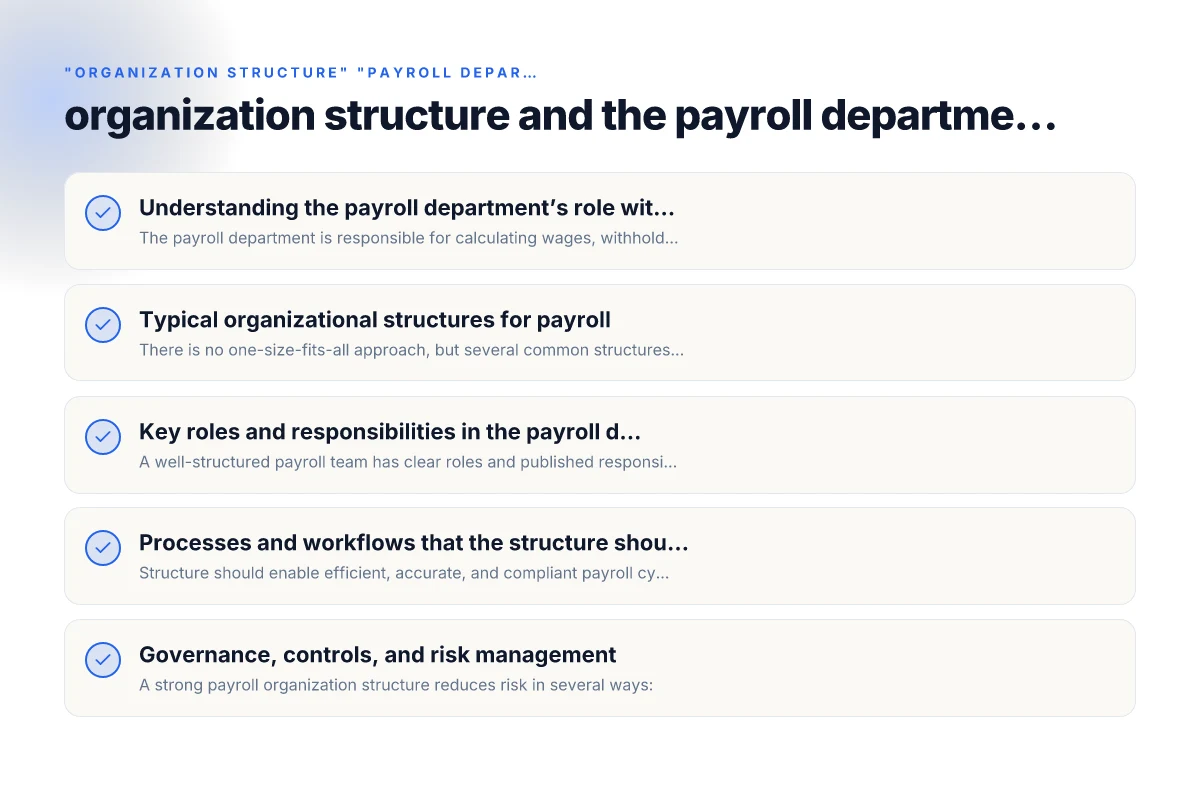
Understanding the payroll department’s role within the organization
The payroll department is responsible for calculating wages, withholding taxes, issuing paychecks or direct deposits, and ensuring regulatory compliance. In many companies, payroll touches multiple areas:
- HR: new hires, terminations, benefits enrollment, and timekeeping data
- Finance: budgeting, cost allocations, and financial reporting
- Compliance: tax filings, labor law adherence, and audit readiness
- IT/Operations: running payroll software, data security, and access controls
A clear delineation of responsibilities prevents handoffs from becoming bottlenecks. It also establishes accountability for every step of the payroll cycle: data collection, validation, calculation, review, posting, and reporting.
Typical organizational structures for payroll
There is no one-size-fits-all approach, but several common structures work well in different sizes and types of organizations. Consider the following patterns and how they map to your company’s needs.
Centralized payroll
- All payroll functions reside in a single department, often reporting to Finance or HR.
- Pros: Consistent processes, centralized data, easier governance, cost efficiencies from economies of scale.
- Cons: Can become a bottleneck if staffing is not aligned with company payroll cycles.
Federated payroll
- Payroll responsibilities are distributed by business unit, geography, or division but with a central payroll policy and governance.
- Pros: Faster response to local rules, better alignment with local HR practices.
- Cons: Requires strong standardization to avoid inconsistent outputs.
Outsourced payroll within the organizational structure
- A core internal payroll team handles governance and data, while a payroll service provider runs calculations or handles specific regions.
- Pros: Access to specialized expertise, reduced system maintenance burden.
- Cons: Dependency on a vendor, potential governance gaps if SLAs aren’t tight.
Hybrid structure
- Core payroll operations are internal and centralized, with regional or functional pods handling local rules or niche needs.
- Pros: Balance of consistency and local adaptation.
- Cons: More complex change management and data integration.
Organizational chart considerations
- Report lines: Who oversees payroll? Common options include Chief Financial Officer (CFO), VP of HR, or a standalone Payroll Director.
- Interfaces: Payroll interacts with HRIS/Timekeeping, Benefits, Tax Compliance, and Controllership.
- Roles: Payroll Manager, Payroll Specialists/Analysts, Time and Attendance Administrator, Tax/Compliance Specialist, Benefits Liaison, and Auditor/Controls Coordinator.
TABLE: Compare centralized vs. federated vs. outsourced layouts | Structure | Pros | Cons | Best for | | Centralized | Consistent processes, unified data, scalable | Potential bottlenecks, single point of failure | Small to mid-size with uniform needs | | Federated | Local compliance, faster local processing | Requires strong governance, potential data fragmentation | Multinational or multi-division organizations | | Outsourced | Access to expertise, reduced internal workload | Vendor risk, data security concerns | Firms prioritizing focus on core business or lacking payroll depth | | Hybrid | Local adaptation with centralized governance | More complex setup and change management | Growing organizations with diverse regions |
Key roles and responsibilities in the payroll department
A well-structured payroll team has clear roles and published responsibilities. Example roles include: Sky go not working with ExpressVPN
- Payroll Director/Manager: Owns payroll strategy, compliance, audits, and governance.
- Payroll Specialist/Analyst: Executes payroll calculations, data validation, exception handling, and reconciliation.
- Time and Attendance Administrator: Manages timekeeping data feeds, attendance policies, and leave calculations.
- Tax/Compliance Specialist: Monitors tax rules, withholdings, filings, and regulatory changes.
- Benefits Liaison: Coordinates deductions for benefits, garnishments, and retirement plan contributions.
- Data/Systems Administrator: Maintains payroll software, security roles, integrations with HRIS and ERP.
- Internal Auditor/Controls Coordinator: Ensures process controls, SOX or internal controls alignment, and audit readiness.
Documentation matters. Maintain:
- Standard operating procedures (SOPs) for each payroll step
- Data dictionaries for all fields used in payroll calculations
- Access control matrices to restrict who can view or modify sensitive data
- Change management records for software updates and policy shifts
Processes and workflows that the structure should support
Structure should enable efficient, accurate, and compliant payroll cycles. Key workflows include:
- Data collection and validation
- Timekeeping integration with payroll, leave balances, new hires, terminations
- Data quality checks before run dates
- Calculation and processing
- Gross pay, deductions, benefits, tax withholdings, and garnishments
- Overtime, bonuses, and special payroll rules
- Review and approvals
- Manager approvals for time off, variances, or one-off payments
- Compliance sign-off for tax filings and regulatory changes
- Disbursement and reporting
- Direct deposit processing, pay cards, check issuance
- Payroll journal postings, reconciliations, and financial reporting
- Compliance and audits
- Tax filings, year-end processes, and regulatory reporting
- Internal and external audits, data privacy considerations
To support these workflows, map data flows between systems (HRIS, timekeeping, benefits, ERP) and establish SLA-based handoffs. Clear SLAs help prevent delays that ripple through to employees.
Governance, controls, and risk management
A strong payroll organization structure reduces risk in several ways:
- Segregation of duties: Separate authorization, processing, and reconciliation steps.
- Access controls: Role-based access to sensitive data and payroll systems.
- Change controls: Formal approval for system changes, tax rule updates, and benefit plan modifications.
- Audit trails: Immutable logs of who did what, when, and why.
- Compliance monitoring: Regular reviews of tax rates, wage orders, and regulatory updates.
Document governance policies and ensure they are reviewed quarterly or when regulations change. A good governance framework supports both internal audits and external examinations with minimal friction. VPN cli: A Practical Guide to Managing VPNs from the Command Line
How to design or redesign your payroll department structure
If you’re starting fresh or considering a redesign, follow these steps:
- Assess current state: Map existing processes, data flows, roles, and pain points. Identify bottlenecks and compliance gaps.
- Define desired state: Choose an organization structure (centralized, federated, outsourced, or hybrid) aligned with business goals, footprint, and risk tolerance.
- Design roles and accountabilities: Create clear job descriptions with responsibilities, required qualifications, and performance measures.
- Align with other functions: Ensure payroll connects cleanly with HR, Finance, and IT. Establish governance committees or working groups if needed.
- Plan for growth: Build scalability into the structure with cross-trained staff, automation opportunities, and outsourcing options for peak cycles.
- Implement with change management: Communicate changes, train staff, and pilot new processes before full rollout.
- Measure and iterate: Track accuracy, cycle time, tax filing timeliness, and employee satisfaction. Use metrics to drive continuous improvement.
Common KPIs for payroll structure effectiveness:
- Cycle time from time data receipt to paycheck issuance
- Payroll accuracy rate (errors per payroll run)
- Tax filing timeliness and accuracy
- Employee inquiry resolution time
- Data integrity across HRIS and payroll systems
- Compliance audit findings and remediation time
Practical expectations: integration with other departments
Payroll does not operate in a vacuum. Effective organization structure integrates payroll with:
- Human Resources: For onboarding, offboarding, benefits, leave, and compensation planning
- Finance: For budgeting, cost centers, accruals, and financial reporting
- Compliance and Legal: For regulatory updates and wage and hour law adherence
- IT and Security: For system security, data protection, and system integration
Clear interfaces and documented SLAs with each interface reduce handoff friction and ensure payroll stays reliable even when teams are stretched.
Final considerations and recommendations
- Start with clarity over complexity: Choose a structure that fits your company’s size, geography, and growth trajectory. It’s easier to scale when roles and processes are explicitly defined from the outset.
- Prioritize governance early: Regardless of structure, establish strong controls, access management, and audit-ready documentation.
- Invest in data quality: Payroll is data-driven. Clean master data, automated validations, and robust integrations pay off with fewer exceptions and faster cycles.
- Build in redundancy and flexibility: Cross-train staff where feasible, and design workflows that can adapt to peak workloads, regulatory changes, or technology upgrades.
- Consider phased outsourcing if appropriate: If cost or expertise limits exist, a managed service or hybrid approach can provide scale while maintaining governance.
In summary, the organization structure around the payroll department sets the tone for how payroll operates, how compliant it is, and how resilient it will be as your business evolves. A centralized, well-governed payroll function with clear roles and strong interfaces to HR, Finance, and Compliance tends to deliver the best combination of accuracy, speed, and risk management. If you are contemplating a redesign, begin with the end in mind: a payroll function that reliably and transparently serves employees and supports organizational objectives. Csl eslim