Does Microsoft Edge come with a built-in VPN

Explains whether Edge includes a built-in VPN, how it works, and how to enable or manage it.
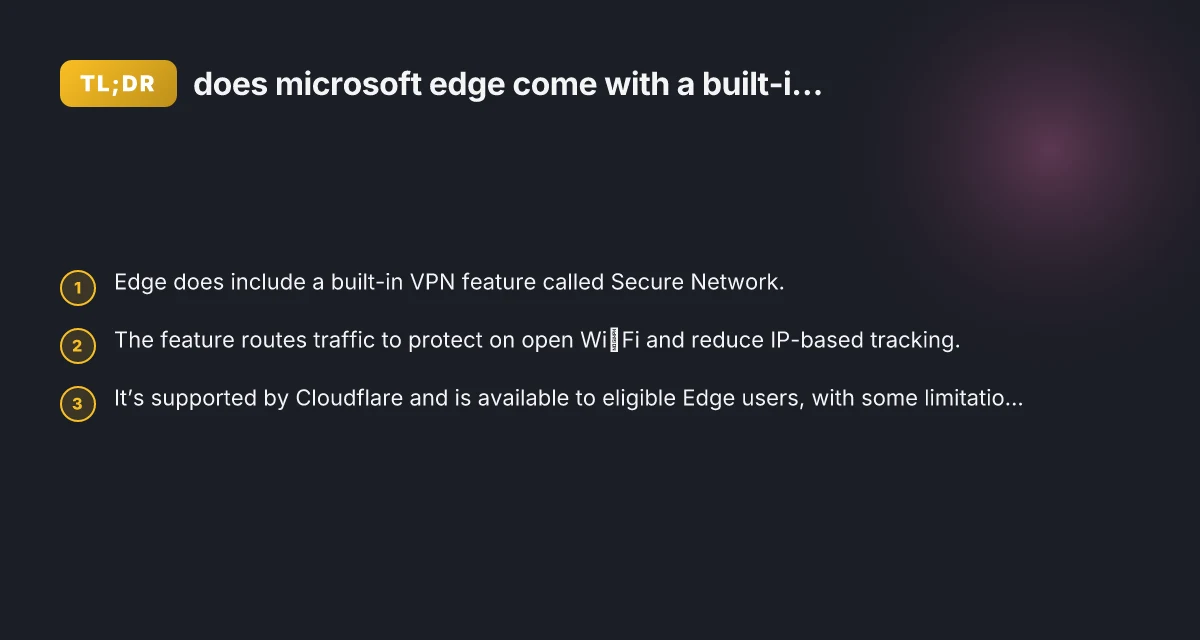
Microsoft Edge does come with a built‑in VPN, but with some important nuances. The feature is commonly referred to as Microsoft Edge Secure Network. It’s designed to help protect your traffic on open or public Wi‑Fi and to reduce exposure to IP‑based tracking. If you’re considering using it, here’s what you need to know, how to enable it, and how it compares to standalone VPN services.

Comparison of Edge Secure Network vs traditional VPN basics
| Feature | Edge Secure Network | Traditional VPN (general) | Free vs paid | Subscription required | Platform availability |
|---|---|---|---|---|---|
| Built-in in Edge | yes | no | varies | yes | Windows, macOS, Android, iOS |
| Separate app needed | no | yes | sometimes | yes | Windows, macOS, iOS, Android |
| User account required | yes (Microsoft account) | yes (vendor account) | usually yes | yes | all major platforms |
| Cost to consumer | included with Edge | usually paid | free tier + paid plans | yes | all major platforms |
| Setup complexity | low | medium to high | varies | varies | multi-platform |
| Privacy controls | basic anonymization | depends on vendor | varies | varies | browser-integrated |
Compiled November 2026; check the provider's site for current details.
What is Microsoft Edge Secure Network?
- Built directly into the Edge browser.
- Uses VPN technology to encrypt traffic and mask IP information on public networks.
- Aimed at improving privacy and security when you’re on open Wi‑Fi.
- Supported by Cloudflare in many configurations, depending on your region and account status.
How it works in practice
- Encrypts traffic from Edge when you’re connected to an unsecured network.
- Routes traffic through an Edge‑provided VPN tunnel to reduce IP exposure.
- Designed as a lightweight privacy enhancement rather than a full‑featured VPN service.
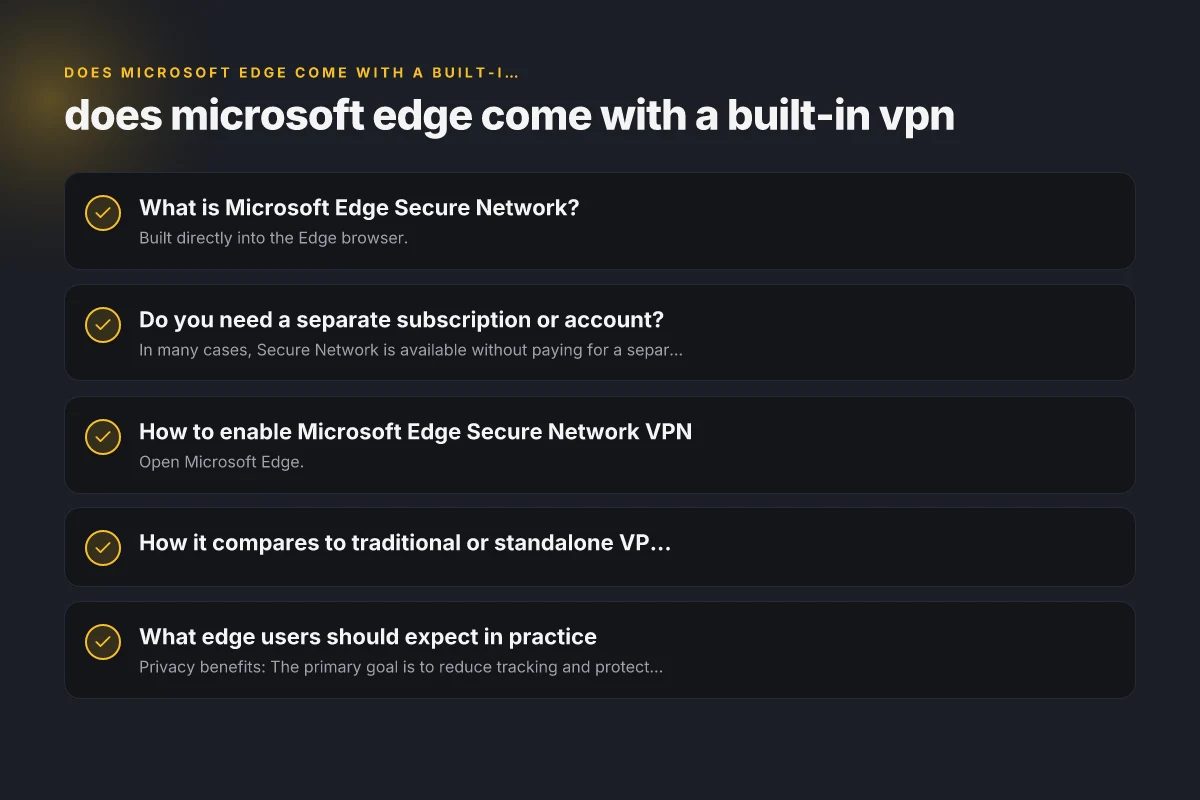
Do you need a separate subscription or account?
- In many cases, Secure Network is available without paying for a separate VPN plan.
- Some Edge configurations rely on a Microsoft account and, in certain regions or builds, may be tied to a Microsoft 365 ecosystem.
- Availability can vary by platform (Windows, macOS, iOS, Android) and by Edge version.
Quick note on limitations
- It’s not a universal replacement for all VPN needs (e.g., it may have data caps or feature limits in some tiers).
- Some advanced VPN features, like exit node choices, multi‑ hop routing, or high‑volume use, may not be available.
- Always verify current terms in Edge settings, as Microsoft can adjust policy and availability.
How to enable Microsoft Edge Secure Network VPN
- Open Microsoft Edge.
- Go to Settings and look for Privacy, search, and services.
- Find an option labeled Secure Network or VPN Service.
- Toggle the feature on, and follow prompts to enable it for your profile.
- If prompted, sign in with a Microsoft account or confirm permissions.
If you can’t find it
- Ensure you’re on a supported Edge version (keep Edge updated).
- Some enterprise or managed devices may have the feature disabled by policy.
- Check regional availability. Not all regions may show the option at the same time.
How it compares to traditional or standalone VPNs
| Aspect | Microsoft Edge Secure Network (built‑in) | Standalone VPN services |
|---|---|---|
| Integration | Edge browser only, built into the browser | System‑wide or per‑app, depending on service |
| Data usage | Typically uses Edge traffic; may have limits | Can be unlimited or have higher caps depending on plan |
| Features | Basic privacy protection, no full control over exit nodes | Full feature sets: multiple servers, protocols, kill switch, split tunneling, etc. |
| Platform coverage | Works where Edge is available (Windows, macOS, iOS, Android) | Typically cross‑device, depending on provider |
| Pricing | Often free with Edge Secure Network, or tied to Microsoft/365 ecosystem | Varies: free plans with limits or paid subscriptions |
How Edge Secure Network compares to standalone VPNs on key usability aspects
| Aspect | Edge Secure Network | Standalone VPN | Ease of use | Speed impact | Device scope |
|---|---|---|---|---|---|
| Activation method | toggle in Edge | app/system toggle | high | moderate to notable | Edge + OS-wide |
| Privacy features | basic IP masking | full features vary | user-friendly | potentially slower | limited to browser/OS |
| Cross-device sync | limited | strong across devices | good | variable | depends on service |
| Customer support | Microsoft support | vendor support | reliable | may be slow | varies |
| Logging policy clarity | summarized in Edge info | varies by provider | clear when documented | varies | varies |
Compiled November 2026; check the provider's site for current details.
What Edge users should expect in practice
- Privacy benefits: The primary goal is to reduce tracking and protect data on open networks.
- Performance: VPN routing can introduce some latency. Typical browsing and light streaming may remain comfortable, but performance can vary by network and server choice.
- Data caps: Some implementations may limit data usage on the built‑in option. Verify your current plan.
- Availability: New features roll out in phases. Not all users may see Secure Network immediately.
Common questions people ask
- Q: Does Edge come with a free VPN? A: Edge includes a built‑in Secure Network VPN feature that is free to use for many users, but availability and limits can vary by region and account type.
- Q: How do I turn on the VPN in Edge? A: In Edge Settings > Privacy, search, and services, look for Secure Network or VPN Service and toggle it on.
- Q: Can I use it on all devices? A: It works on Edge across supported platforms, but some devices or enterprise setups may restrict use.
- Q: Is it the same as a traditional VPN? A: It provides VPN‑style protection for Edge traffic, but may lack some advanced capabilities of dedicated VPN services.
Practical expectations and limitations when using Edge’s built-in VPN
| Topic | Edge expectation | Traditional VPN expectation | Real-world speed | Data caps | Availability of servers |
|---|---|---|---|---|---|
| Protection level | IP masking in browser | full device tunnel | speed may drop | no cap or unknown | many regions (variable) |
| System-wide protection | no (browser only) | yes | latency may increase | not typical | depends on app |
| Streaming access | good for some services | varies by provider | streaming-friendly sometimes | may restrict | many regions |
| Geo-unblocking | possible for some sites | broader | site-dependent | no strict cap | many locations |
| Logging exposure | limited to browser data | depends on provider | low when used properly | not specified | varies by provider |
Compiled November 2026; check the provider's site for current details.
Who should consider using Edge’s built‑in VPN?
- If you frequently use public Wi‑Fi and want a quick privacy boost without installing extra software.
- If you primarily browse within Edge and value an integrated privacy option.
- If you are curious about VPN basics and want a no‑friction way to test the concept.
When you might prefer a separate VPN service
- You need device‑wide protection (not just Edge) across all apps.
- You require advanced features (server choice, split tunneling, kill switch, no‑logs guarantees).
- You want consistent performance or higher data allowances across multiple devices.
Final recommendation
If your primary goal is to add a simple layer of protection while browsing in Edge on public Wi‑Fi, Microsoft Edge Secure Network is a convenient built‑in option to try. It’s easy to enable, does not require a separate subscription in many cases, and is designed to protect Edge traffic from IP‑based tracking. However, if you need comprehensive, device‑wide VPN coverage or advanced features, you should also evaluate a standalone VPN service that matches your needs. As with any privacy tool, it’s best to review current official guidance in Edge settings and Microsoft’s documentation for your region and platform to understand current limits, pricing (if any), and availability. Sky router br440 VPN issues
| VPN | From / month | Plan | Free plan | Refund | Alipay | UnionPay | Crypto | Website opens in China | Trustpilot | |
|---|---|---|---|---|---|---|---|---|---|---|
 ZoogVPN | $2.49/mo | 27 months: $59.99 | Yes | 7 days | ✓ | ✓ | ✓ | ✓ | ✓ Yes (2.5 s) | 4.2/5 (195 reviews) |
 NordVPN | $3.49/mo | 27 months: $94.23 | No | 30 days | ? | ✗ | ✓ | ✓ | ✗ Blocked | 4.2/5 (51,628 reviews) |
 ExpressVPN | $3.00/mo | 28 months: $84 | No | 30 days | ✗ | ✗ | ✓ | ✗ | ✗ Blocked | 4.4/5 (29,706 reviews) |
 Surfshark | See site | See site | No | 30 days | ✗ | ✗ | ✗ | ✓ | ✗ Blocked | 4.3/5 (31,823 reviews) |
 Proton VPN | $2.99/mo | 12 months: $35.88 | Yes | 30 days | ✗ | ✗ | ✗ | ✓ | ✓ Yes (2.5 s) | 2.1/5 (1,040 reviews) |
 Astrill VPN | $12.50/mo | 24 months: $300 | No | See site | ✗ | ✗ | ✗ | ✓ | ✗ Blocked | 1.3/5 (110 reviews) |
 Private Internet Access | $2.03/mo | 40 months: $81.2 | No | 30 days | ✗ | ✗ | ✗ | ✗ | ✗ Blocked | 4.2/5 (11,033 reviews) |
 CyberGhost | $2.19/mo | 28 months: $61.32 | No | 45 days | ✗ | ✗ | ✗ | ✓ | ✗ Blocked | 4.0/5 (24,178 reviews) |
 PureVPN | $1.69/mo | 60 months: $101.55 | No | 31 days | ? | ✗ | ✗ | ✓ | ✓ Yes (2.6 s) | 4.4/5 (17,994 reviews) |
 AdGuard VPN | $2.99/mo | 24 months: $71.76 | Yes | 30 days | ✓ | ✗ | ✓ | ✓ | Official site blocked; our special link opens (2.3 s) | 4.3/5 (290 reviews) |
 Mullvad | $5.61/mo | €5/mo | No | 14 days | ✗ | ✗ | ✗ | ✓ | ✗ Blocked | 3.2/5 (192 reviews) |
 Windscribe | $5.75/mo | 12 months: $69 | Yes | See site | ✗ | ✗ | ✗ | ✓ | ✗ Blocked | 4.7/5 (13,355 reviews) |
 StrongVPN | See site | See site | No | 30 days | ✓ | ✗ | ✗ | ✗ | ✗ Blocked | 4.4/5 (2,695 reviews) |
 LightXtreme 闪连 | $7.08/mo | 12 months: $84.99 | Yes | 30 days | ✓ | ✓ | ✓ | ✓ | ✓ Yes (2.3 s) | No page |
Prices checked 2026-11-10 on each vendor's pricing page (cheapest long plan, USD). Check the vendor's checkout for the final price.
Payment methods checked 2026-11-10 on each vendor's payment pages: all 14 take cards and PayPal; ✗ = not listed, ? = the vendor's own pages disagree.
China access: whether the official website opens from mainland China networks (tests the website only, not the VPN connection). Last checked 2026-11-11 04:07 Beijing time.
Trustpilot score and review count checked 2026-11-10.