Is Proton VPN slow

A practical guide to understanding Proton VPN speeds, why they slow down, and how to optimize performance.
Proton VPN is a reputable VPN service that aims to balance strong security with usable speeds. But as with any VPN, your experience of speed can vary widely based on where you connect, what protocol you use, and how your local network performs. In short: Proton VPN can feel slow at times, but there are clear, reliable steps you can take to improve it. This guide walks you through why speeds slow down and what you can do about it.

Speed factors at a glance
| Factor | Impact on Proton VPN speed | Typical range impact | Notes |
|---|---|---|---|
| Server distance | High | 50–70% change | farther = slower |
| Server load | Medium | 10–30% change | high load reduces speed |
| Protocol type (e.g., WireGuard) | High | 20–60% change | newer protocols faster |
| Encryption level | Medium | 5–15% change | same cipher, overhead varies |
| Local network | Low | 0–5% change | Wi‑Fi to router matters |
| ISP throttling | Variable | Yes/No | dependent on ISP |
Compiled November 2026; check the provider's site for current details.
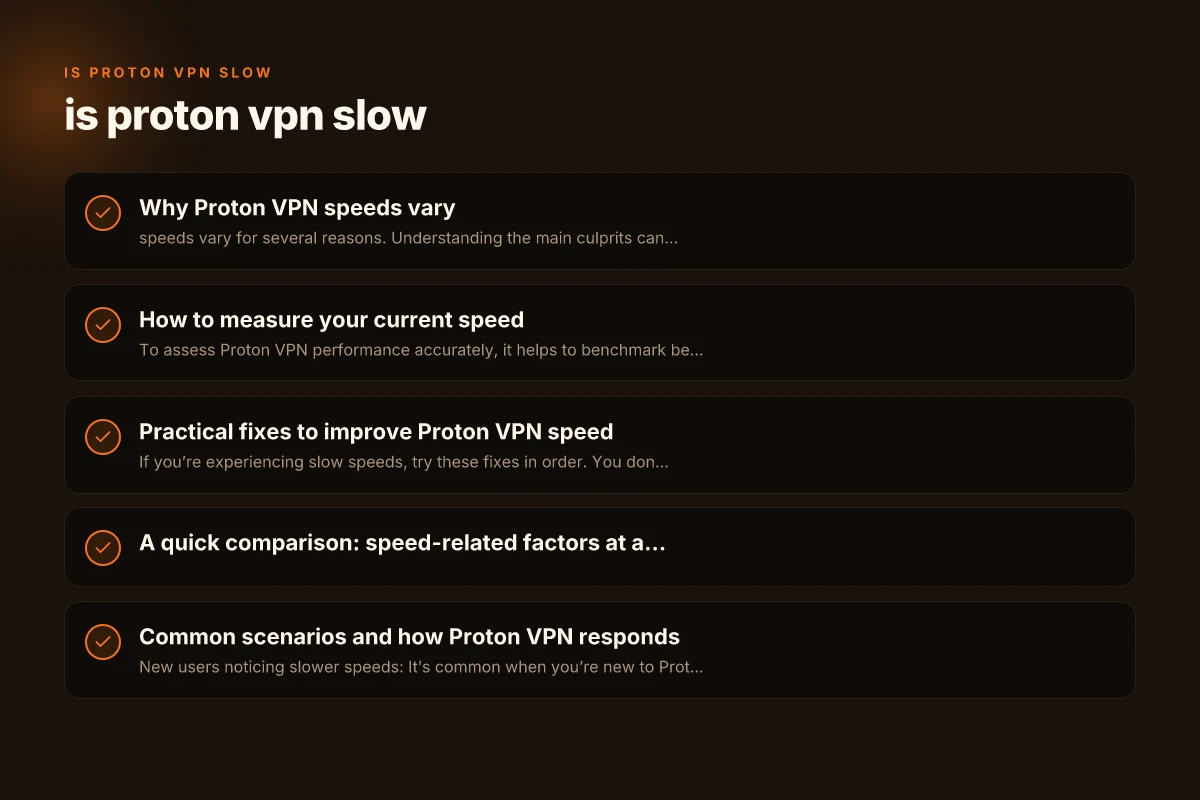
Why Proton VPN speeds vary
speeds vary for several reasons. Understanding the main culprits can help you diagnose and fix issues quickly.
Distance to the server
- The farther you are from a Proton VPN server, the more latency you’ll experience.
- Long distances mean more hops and potential congestion, which can reduce throughput.
Server load
- Popular servers can become busy, especially during peak hours.
- Proton VPN shows server load indicators, but even a “fast” server can feel slower if many users connect simultaneously.
Protocol choice
- Proton VPN offers different protocols (e.g., WireGuard, OpenVPN, and IKEv2). Each has trade-offs between speed and encryption overhead.
- Some protocols are faster with certain devices or networks but may not be available on all plans.
Encryption overhead and overhead on your device
- Strong encryption is essential for privacy, but it adds CPU overhead.
- Older devices or devices with limited CPU power can experience more noticeable slowdowns.
Local network conditions
- If your home network or your ISP imposes throttling or has high congestion, VPN speeds can be affected.
- Wi-Fi signal quality, background apps, and other devices using bandwidth can also influence results.
VPN app behavior and settings
- Default settings are designed for balance, not maximum speed.
- Features like CyberSec, split tunneling, or auto-connect rules can influence performance.
How to measure your current speed
To assess Proton VPN performance accurately, it helps to benchmark before and after changes.
Baseline steps
- Run a speed test (without VPN) at a similar time of day to your VPN tests.
- Connect to Proton VPN and choose a nearby server initially.
- Run the same speed test with the VPN active.
What to compare
- Download speed (Mbps)
- Upload speed (Mbps)
- Latency (ms, ping)
- Jitter (variance in latency)
Interpreting results
- A drop of 10–30% in download speed is common when using a VPN, depending on the factors above.
- If you see a much larger drop or unstable latency, it’s a sign to try adjustments.
Practical fixes to improve Proton VPN speed
If you’re experiencing slow speeds, try these fixes in order. You don’t have to apply all at once. Small changes can yield noticeable improvements.
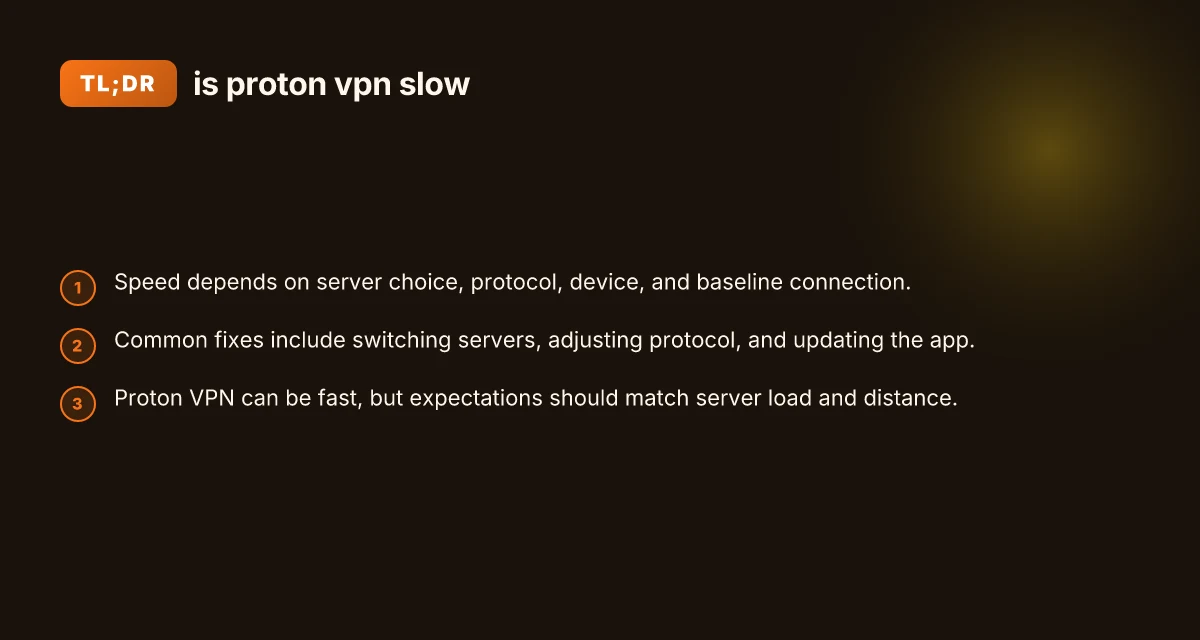
1) Switch servers
- Use Proton VPN’s “Fastest” profile as a starting point, then manually pick a server that’s geographically closer or less loaded.
- Try a different country or city, and check the server load indicator.
2) Change the protocol
- WireGuard is typically faster and more efficient than OpenVPN on most devices.
- If your device or network has issues with WireGuard, testing OpenVPN or IKEv2 can be worthwhile.
- Proton VPN makes these options accessible in the settings or connection interface.
3) Update Proton VPN and device software
- Ensure you’re on the latest Proton VPN app version to benefit from performance fixes and optimizations.
- Update your device’s OS and network drivers if applicable.
4) Adjust encryption and tunneling options
- Some configurations emphasize speed over features. If you’re not using advanced security features, a simpler setup can be faster.
- Consider enabling split tunneling for traffic that doesn’t need VPN protection, if supported.
5) Check your local network
- Run a speed test with VPN off to see if your baseline is already slow.
- Restart your router, check for competing devices, and switch to a 5 GHz Wi‑Fi band if possible.
- If you’re on a congested public network, a VPN might feel slower than on a clean home network. In that case, try a different time of day.
6) Optimize device performance
- Close bandwidth-heavy apps in the background.
- On mobile devices, disable battery saver modes that limit network activity.
- Ensure sufficient free RAM and CPU headroom during VPN use.
7) Consider your plan and features
- Proton VPN offers multiple plans with different server access and performance characteristics.
- If your current plan limits access to faster servers or features, upgrading can improve speeds in some cases.
How to measure current speed vs baseline
| Step | Action | What to record | Best indicator |
|---|---|---|---|
| 1 | Run native speed test | Mbps down / up | Baseline without VPN |
| 2 | Connect to VPN, same server | Mbps down / up | Compare to baseline |
| 3 | Change server location | Mbps new | Fastest observed |
| 4 | Switch protocol | Mbps with WireGuard/OpenVPN | Higher is better |
| 5 | Check latency | ms ping | Lower is better |
| 6 | Restart app/device | – | Consistent results |
Compiled November 2026; check the provider's site for current details. How to whitelist websites on NordVPN
A quick comparison: speed-related factors at a glance
| Factor | How it affects speed | Quick fixes |
|---|---|---|
| Server distance | Higher latency, lower throughput | Connect to a nearby server; use Fastest as a starting point |
| Server load | More users share capacity | Try alternates with lower load; avoid peak times |
| Protocol | WireGuard often faster; OpenVPN can be slower | Switch protocol in app settings; test both |
| Device CPU & RAM | Higher encryption overhead can slow older devices | Close apps; upgrade device if feasible |
| Network type | Home Wi‑Fi vs mobile data | Prefer stable, wired or high-quality Wi‑Fi where possible |
| Features enabled | Security features can add overhead | Turn off nonessential features (e.g., CyberSec) temporarily |
Common scenarios and how Proton VPN responds
- New users noticing slower speeds: It’s common when you’re new to Proton VPN and testing different servers or profiles. Start with Fastest, then experiment with nearby servers.
- Torrenting or P2P: Some servers are optimized for P2P traffic. If speed is the goal, switch to a server known for P2P and use WireGuard when available. Note that some regions or servers may restrict P2P traffic. Always check Proton VPN’s terms and server notes.
- Streaming: Streaming often benefits from fast, stable connections. A nearby server with WireGuard and a non-blocked streaming endpoint tends to perform best.
Practical fixes to improve Proton VPN speed
| Fix | Applies to | Expected effect | Quick feasibility |
|---|---|---|---|
| Choose closer server | Yes | Speed up | Easy |
| Switch to WireGuard | Yes | Higher throughput | Easy |
| Use split tunneling | Yes | Keeps local traffic fast | Easy |
| Avoid peak hours | Yes | Less congestion | Moderate |
| Disable IPv6 | Yes | Reduce overhead | Easy |
| Update app | Yes | Performance gains | Easy |
Compiled November 2026; check the provider's site for current details.
Common myths and clarifications
- Myth: Proton VPN is inherently slow because of its security. Reality: Encryption adds overhead, but with the right server, protocol, and device setup, Proton VPN can be quite fast. It’s often speed-neutral with well-optimized configurations.
- Myth: Free VPNs are always slower. While some free options cap bandwidth or overload servers, Proton VPN’s free tier is designed with usable speeds, though premium plans typically provide more options and better performance.
- Myth: If it’s slow on one device, it will always be slow. Reality: Speed varies by device and OS. A desktop with modern hardware can outperform an older smartphone, especially under load.
Practical tips for sustained speed health
- Regularly check server status and load indicators before you connect.
- Keep your Proton VPN app up to date to benefit from improvements.
- Create a small routine: pick a nearby server, test, then swap to a second option if needed, and finalize with your preferred one for daily use.
- If you consistently need high speeds for streaming or large downloads, consider a plan that gives you access to more high-performance servers.
Final recommendation
If you’re wondering, “Is Proton VPN slow?”, the honest answer is: it can be, but it’s highly dependent on your setup. Start with the basics: choose a nearby server, switch to WireGuard, and ensure the app and device software are current. If you still notice sluggish performance, broaden your testing to multiple servers, and adjust your network environment or device settings. In most everyday use cases, browsing, streaming, light gaming, Proton VPN speeds are competitive when you apply targeted, practical optimizations.
If you want a concise rule of thumb:
- Always test a nearby server with WireGuard first.
- If speeds lag, try a different nearby server with a lighter load.
- Update the app and your device, and reduce background network activity.
- Reserve the “Fastest” profile as a starting point, then manually tune for your specific needs.
With these steps, you’ll typically see a meaningful improvement in Proton VPN speeds, making the experience smoother without sacrificing the privacy protections you expect. How to easily disable VPN or proxy on your TV