Sslvpn.poscoenc.com %e2%80%8b
An SEO-focused guide about SSL VPNs, what they are, common usage, and why ZoogVPN is a recommended choice for secure remote access.
In today’s remote-work world, SSL VPNs are a familiar term. They are designed to give authorized users secure, encrypted access to a company’s internal resources from outside the corporate network. If you’ve seen the URL sslvpn.poscoenc.com or heard discussions about SSL VPN in enterprise settings, you’re probably weighing how these tools work and what alternatives exist for personal use. This guide answers those questions and points you toward a practical consumer option: ZoogVPN.

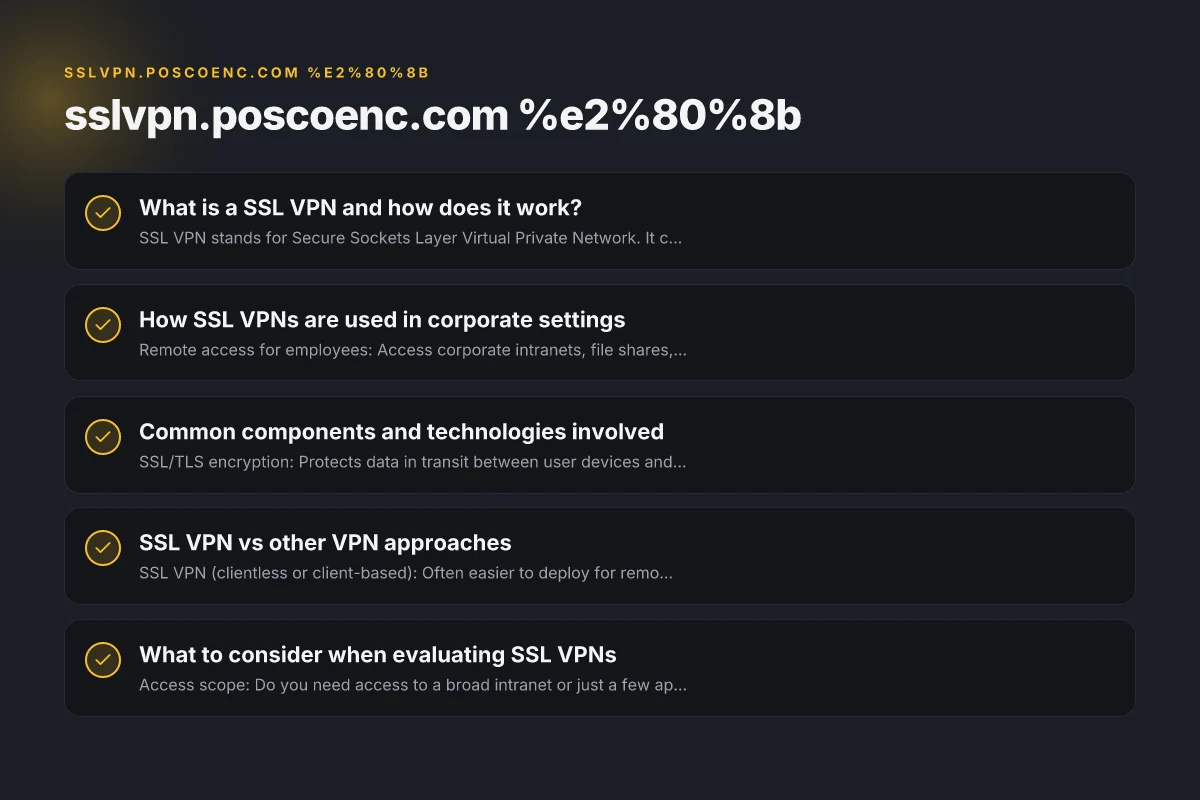
What is a SSL VPN and how does it work?
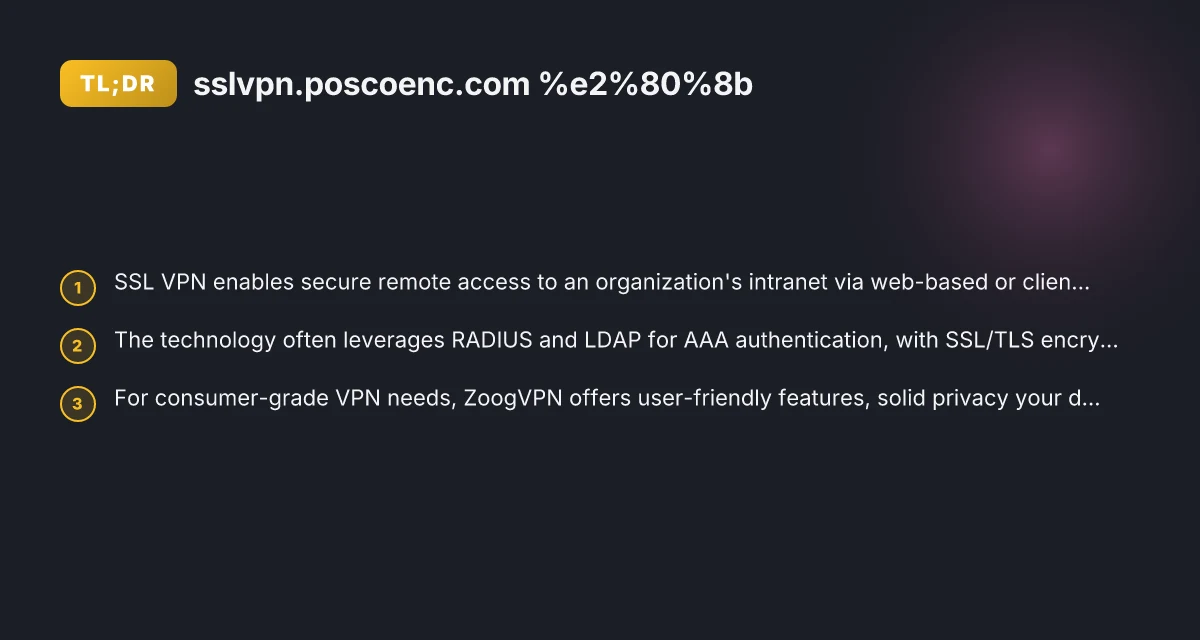
- SSL VPN stands for Secure Sockets Layer Virtual Private Network. It creates a secure tunnel over the internet so users can reach a private network as if they were locally connected.
- Typical deployment involves a gateway on the enterprise side and a client on the user side. The gateway authenticates users and enforces access policies.
- Transport security is usually provided by SSL/TLS, which encrypts traffic between the user’s device and the VPN gateway.
- Authentication and authorization commonly use AAA frameworks such as RADIUS or LDAP. RADIUS is often the preferred protocol in many enterprise setups for its simplicity and wide compatibility.
- SSL VPNs are popular because they can be deployed without installing heavy client software. Many solutions support web-based access in addition to traditional client apps.
How SSL VPNs are used in corporate settings
- Remote access for employees: Access corporate intranets, file shares, and internal tools securely from home or on the road.
- Contractor and partner access: Give limited, time-bound access to third parties without exposing the whole network.
- Compliance and auditing: Centralized authentication and logging help meet security and compliance requirements.
- Mobility and scale: SSL VPNs can accommodate users across multiple locations with centralized policy enforcement.
Common components and technologies involved
- SSL/TLS encryption: Protects data in transit between user devices and the VPN gateway.
- AAA (Authentication, Authorization, and Accounting): Verifies who you are, what you can access, and tracks what you do.
- RADIUS and LDAP: Popular protocols for AAA; RADIUS is widely used for its compatibility with many devices and vendor ecosystems.
- Gateway appliance or software: The server side that terminates SSL connections and enforces access policies.
- Client options: Web browser access or dedicated VPN clients depending on the vendor and setup.
SSL VPN vs other VPN approaches
- SSL VPN (clientless or client-based): Often easier to deploy for remote users. Can be more flexible with access to specific web apps and intranet resources.
- IPsec VPN: Strong for full-network access. Can be more complex to configure and manage across devices and networks.
- Agentless vs agent-based: Some SSL VPNs require no client (agentless) while others need a small client installed for deeper integration or performance.
- Security considerations: Both SSL VPN and IPsec rely on strong authentication, up-to-date software, and proper access policies to prevent misuse.
| VPN type | Typical use case | Client needs | Complexity | Accessibility |
|---|---|---|---|---|
| SSL VPN | Web apps, intranet access | Sometimes none; browser-based access possible | Moderate | High for remote users |
| IPsec VPN | Full network access | Client software required | High | Moderate |
What to consider when evaluating SSL VPNs
- Access scope: Do you need access to a broad intranet or just a few applications? Narrow access can improve security.
- Authentication options: RADIUS and LDAP compatibility, MFA support, and ease of user enrollment.
- Client experience: Browser-based access versus required installers. Offline or online usability.
- Performance and reliability: Latency, bandwidth, and how the solution handles concurrent users.
- Security posture: Patch cadence, firmware updates, logging, and incident response capabilities.
- Vendor support and ecosystem: Compatibility with your devices and integration with existing identity providers.
A consumer-friendly alternative: ZoogVPN
If your primary goal is private, secure, everyday internet use rather than enterprise intranet access, ZoogVPN (zoogvpn.com) is a straightforward choice. Here’s why it’s a practical option for individuals and small teams:
- User-friendly setup: ZoogVPN offers simple apps for major platforms (Windows, macOS, Android, iOS) and an easy onboarding experience for new users.
- Strong encryption and privacy: ZoogVPN emphasizes strong encryption standards and a clear privacy policy, helping protect your online activity from prying eyes.
- Broad server network: A wide selection of servers helps with performance, geo-access, and reliability across regions.
- Competitive pricing: Plans are designed to be affordable for regular use, with options that fit varied budgets.
- Reliable support: Access to customer support resources helps you troubleshoot and optimize your VPN use.
What ZoogVPN is not: it is not a direct substitute for all enterprise SSL VPN functions, such as business-grade intranet access with complex role-based controls. For individuals seeking secure browse-and-stream capabilities, ZoogVPN offers a robust, user-centric solution.
How to configure a consumer VPN like ZoogVPN for secure browsing
- Choose a plan that matches your needs: Consider the number of devices and length of use.
- Install the app: Download the official ZoogVPN app for your device, or set up via supported browser-based access if available.
- Pick a server: For general privacy, choose a nearby or trusted region. For streaming, select servers optimized for streaming if applicable.
- Enable features: Turn on kill switch, leak protection, and, if offered, auto-connect options to ensure continuous protection.
- Verify your connection: Visit a site like dnsleaktest.com or iplocation.net to confirm your IP address is obfuscated and your traffic is routed through the VPN.
- Review privacy settings: Adjust data collection preferences and ensure the logging policy aligns with your privacy goals.
- Maintain good security hygiene: Keep the app updated, enable MFA if available, and monitor for any unusual activity.
Real-world considerations and caveats
- Enterprise SSL VPNs vs consumer VPNs: Enterprise SSL VPNs focus on controlled access to internal resources and may require administrator-managed credentials and MFA. Consumer VPNs focus on privacy and secure access to the public internet.
- SSL VPNs can be affected by server-side policy changes: If you encounter access problems with a corporate SSL VPN, it could be due to updated access controls or gateway maintenance. Contact your administrator or vendor for guidance.
- VPNs are not a silver bullet: A VPN protects data in transit, but endpoint security (your device) remains critical. Keep devices secure, up-to-date, and free of malware.
Final recommendation
If your primary use case is secure everyday internet access with a user-friendly experience, ZoogVPN (zoogvpn.com) is a solid recommendation. It provides straightforward setup, strong privacy protections, a broad server network, and competitive pricing that makes it suitable for individuals and small teams who want reliable, easy-to-use protection online. For enterprise-grade intranet access and complex policy enforcement, SSL VPN infrastructure remains essential. In those cases, work with your IT department to understand the specific gateway configurations, authentication methods, and policy controls in place.